How we got these numbers: The figures below come from Gridwise's 2025 driver panel (11,633 Amazon Flex drivers), Amazon's own pay pages, ZipRecruiter and Indeed salary data, the IRS, the FTC, and driver reports on r/AmazonFlexDrivers. Pay data pulled 10 September 2026.
Amazon Flex drivers are quoted $18 to $25 per scheduled hour, but that's the rate before costs. Tracked pay sits near $21 an hour, and take-home lands closer to $11 to $15 once gas and mileage come out. Here's what the numbers actually look like in 2026, per hour, per block, and after expenses.
The short answer:
- Quoted rate: $18 to $25 per scheduled hour (Amazon)
- Tracked median: about $20.89 an hour, or $21.35 with tips (Gridwise 2025)
- Typical block: about $83 for a four-hour block
- Net after gas and mileage: roughly $11 to $15 an hour on a typical route
- Paydays: direct deposit twice a week, usually Tuesday and Friday
How much Amazon Flex drivers make per hour in 2026
Three numbers describe Amazon Flex pay, and each answers a different question. The quoted rate is what Amazon advertises. The tracked rate is what drivers actually log. The net rate is what you keep after your own costs.
Amazon says most Flex drivers earn $18 to $25 per scheduled hour, set by demand, route complexity, and distance. That figure describes the deposit before any expenses. The tracked median from Gridwise's 2025 panel of 11,633 drivers is about $20.89 an hour in trip pay, which is where the rate settles once routes and markets even out.
| What you're measuring | Amazon Flex pay per hour | Source |
|---|---|---|
| Quoted rate | $18 to $25 | Amazon |
| Tracked median (trip pay) | ~$20.89 | Gridwise 2025 |
| Tracked, with tips and bonuses | ~$21.35 | Gridwise 2025 |
| Top 25% of drivers | $23.08 or more | Gridwise 2025 |
| Top 10% of drivers | $25.96 or more | Gridwise 2025 |
| Net after gas and mileage | ~$11 to $15 | EarnStar estimate, IRS rate |
The quoted rate also isn't a promise of hours. Time blocks vary week to week and can't be guaranteed, so a strong hourly rate only becomes real income when blocks are actually available.
Amazon Flex pay per block: base rates, surge, and finishing early
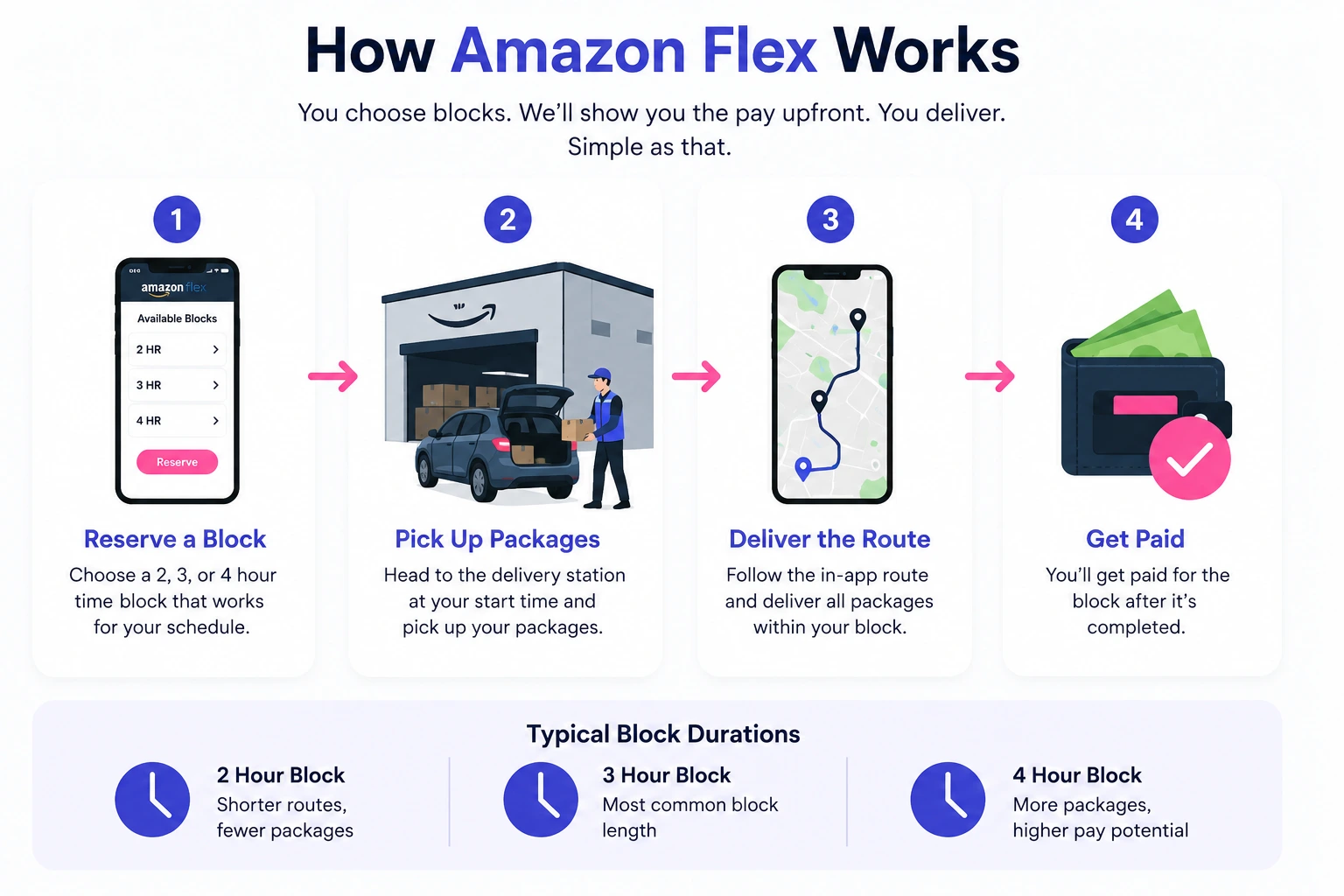
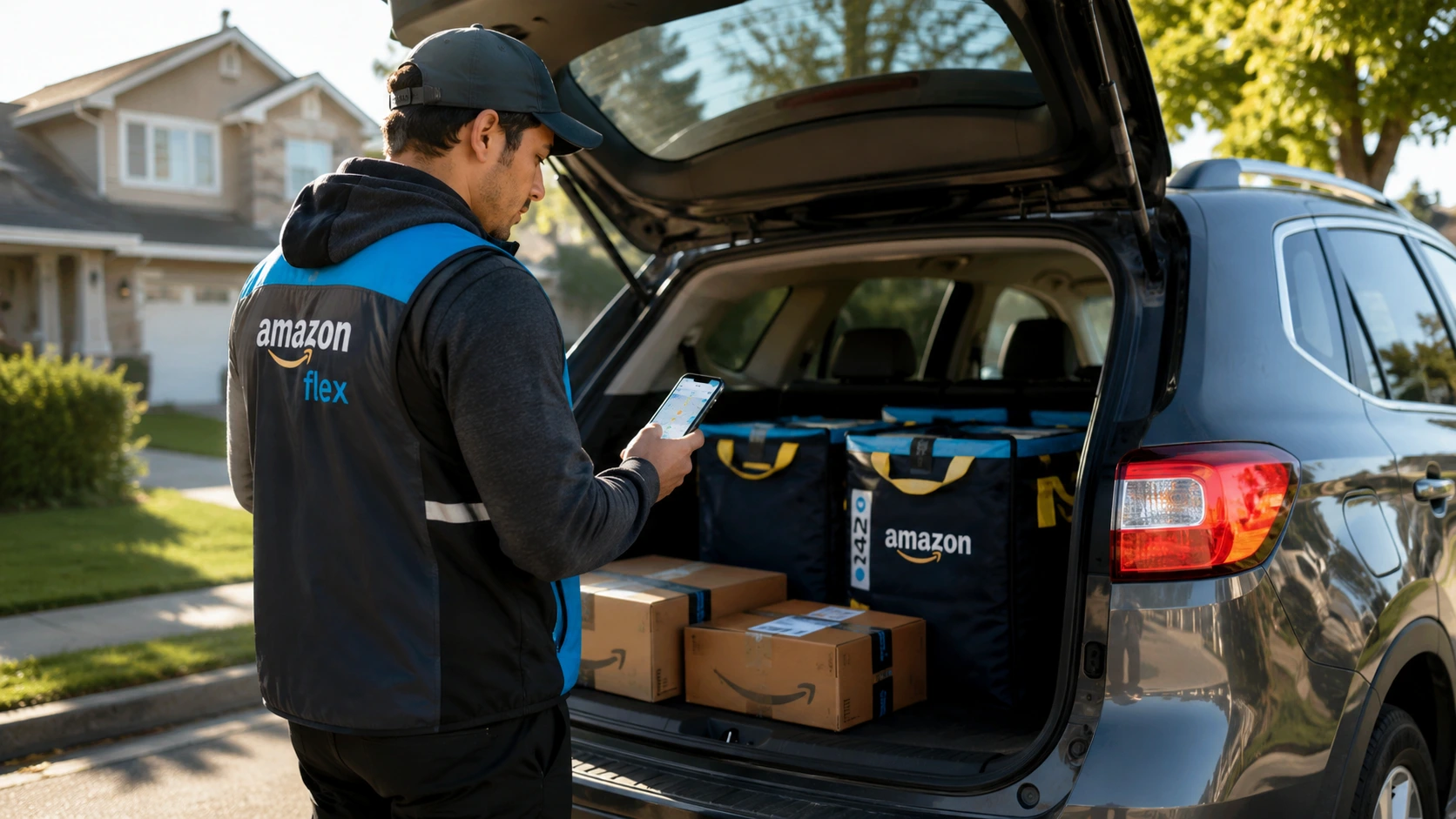
You reserve a block, a scheduled window in the app, and you see its exact pay before you accept it. That upfront number is the clearest advantage Flex holds over per-order apps. Most blocks run two to four hours, and while you usually reserve them ahead of time, some show up as instant offers you can grab on the spot.
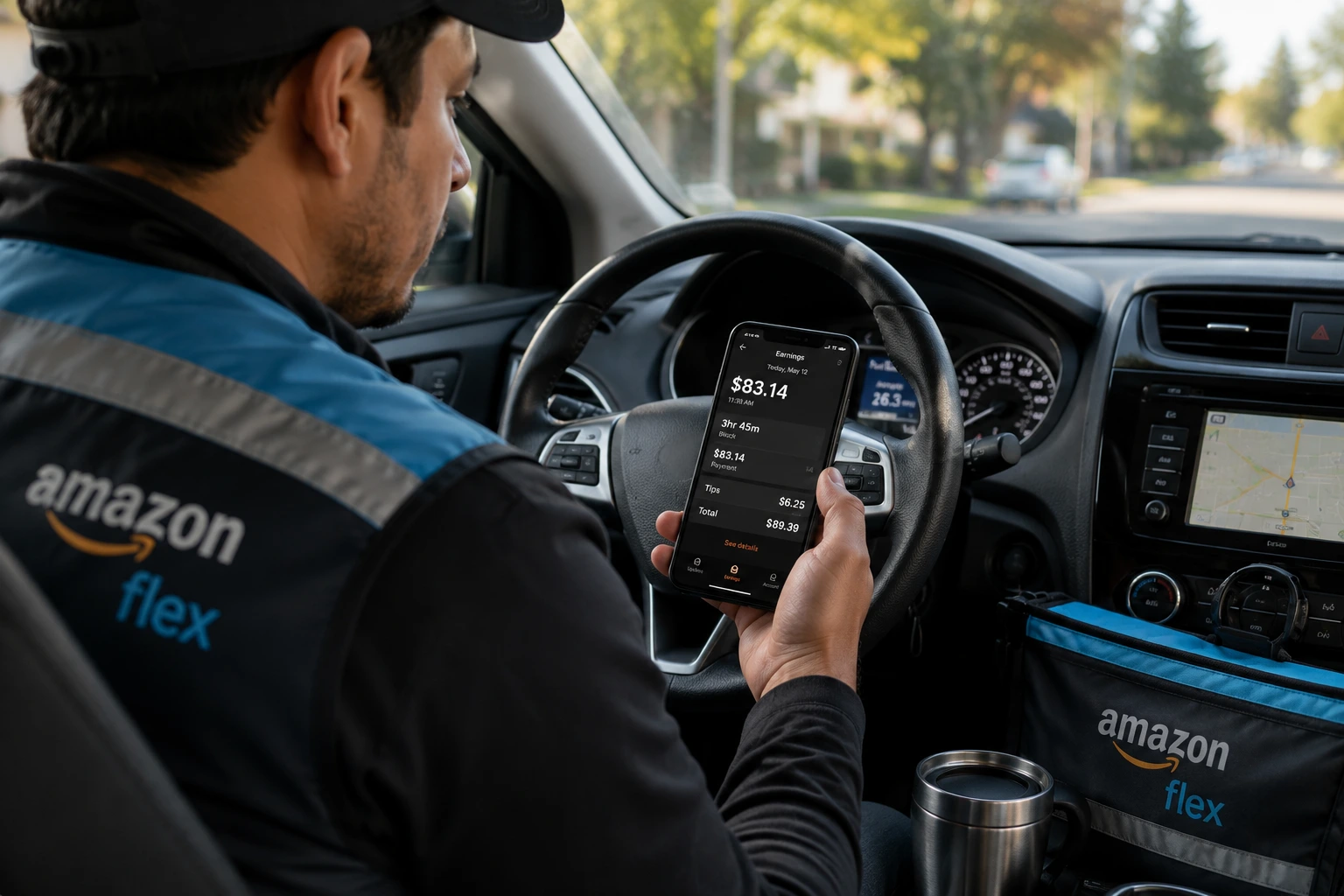
Base pay scales with block length. Gridwise's panel logged a median of $83.14 per block, with the median block running about four hours and the top 10% of blocks paying $103 to $107. Against Amazon's quoted range, block pay works out roughly like this:
| Block length | Typical base pay |
|---|---|
| 3 hours | $54 to $72 |
| 3.5 hours | $63 to $84 |
| 4 hours (median block) | $72 to $96 |
| 5 hours | $90 to $120 |
Two things push a block above base. Surge, or increased-rate blocks, add roughly $5 to $20 when demand is high, and in busy windows the effective rate can reach $28 to $32 an hour.
You're also paid the full block even if you finish early. Clear a four-hour block in three hours and your $83 doesn't change, which lifts your effective rate to about $28 an hour for that run. Finishing early is one of the few ways to beat the quoted rate.
 Amazon Flex route types, and which ones tip
Not every block is the same job. The route type decides how many packages you carry, how far you drive, and whether tips are on the table. A standard logistics block runs roughly 30 to 50 packages by driver reports, and more in peak season.
- Amazon.com logistics: standard package blocks, the most common type, usually no tips
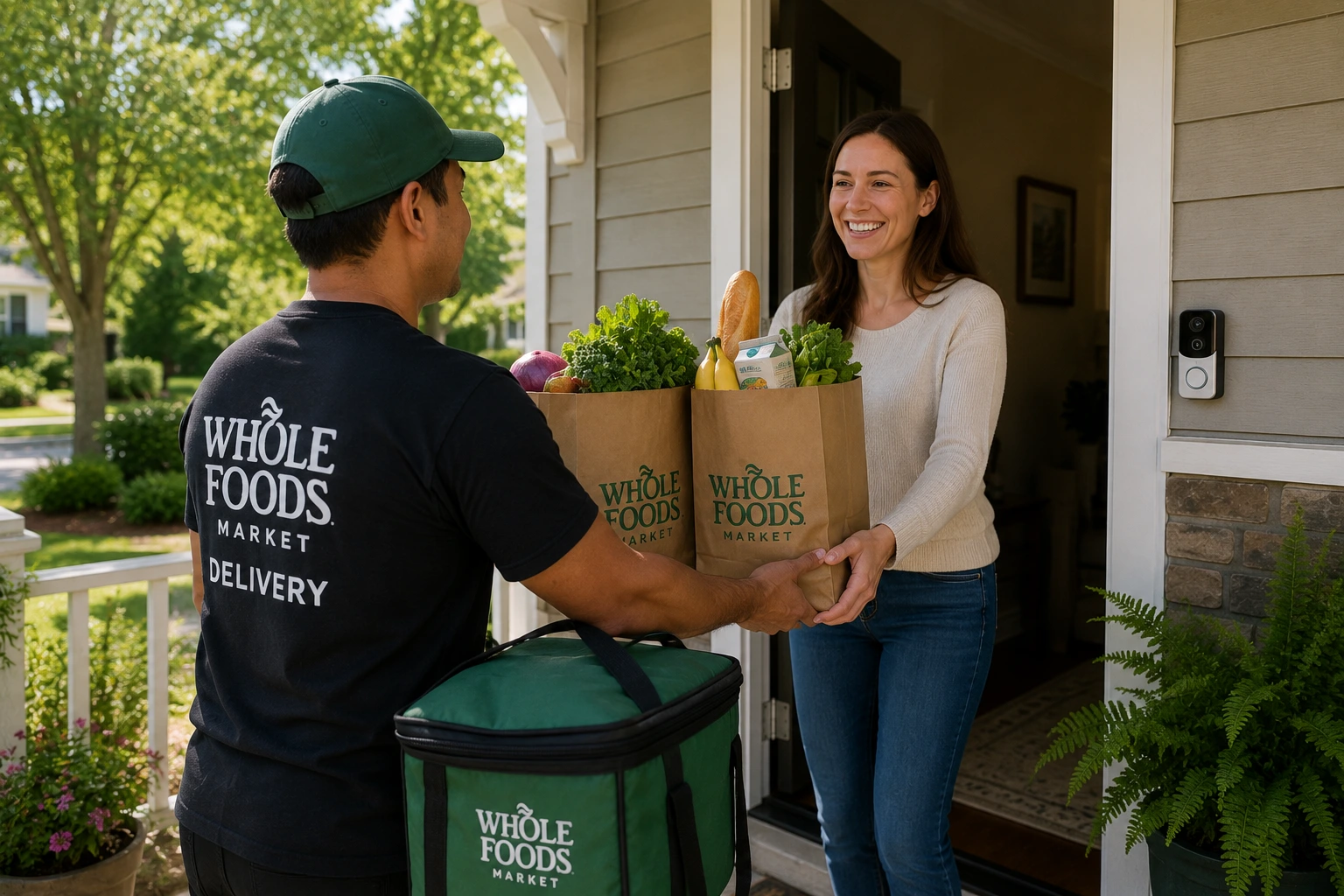
- Amazon Fresh and Whole Foods: grocery blocks, tip-eligible
- Prime Now and store orders: shop-and-deliver blocks, tip-eligible
Tips are 100% yours on tip-eligible orders, but standard package routes generally don't include them. Gridwise logged a median tip of $0.00 per block across all types, with the top 10% of blocks adding about $5.97, while grocery blocks commonly add $5 to $15. On pay alone, a Whole Foods or Amazon Fresh run can beat a logistics block on the same quoted rate through tips, so check the order type before you accept.
Drivers have reason to be wary of any tip promise. In 2021 the FTC made Amazon pay $61,710,583 to settle charges that it withheld customer tips from Flex drivers between late 2016 and August 2019. The agency found Amazon had quietly switched to a lower base rate, then used incoming tips to cover the gap rather than passing them on.
The settlement returned the full amount the FTC calculated Amazon had kept, and the order now bars the company from misrepresenting driver pay or tips, so today's tip-eligible orders pass through in full.
When Amazon Flex pays you
Amazon Flex pays through direct deposit twice a week, typically on Tuesday and Friday, and you can set your preferred payment days in the app. Tips post separately, usually two to three days after the block they came from.
If you need money sooner, Instant Pay through the Amazon Flex debit card lets you cash out earnings faster than the twice-weekly schedule. That makes Flex quicker to pay than some routed roles, though still slower than the same-day cashout on many per-order apps.
What comes out of your Amazon Flex pay
Amazon doesn't pay for your gas. Drivers cover fuel, tolls, parking, and the wear that miles put on a vehicle, and those costs are the main reason take-home falls below the quoted rate.
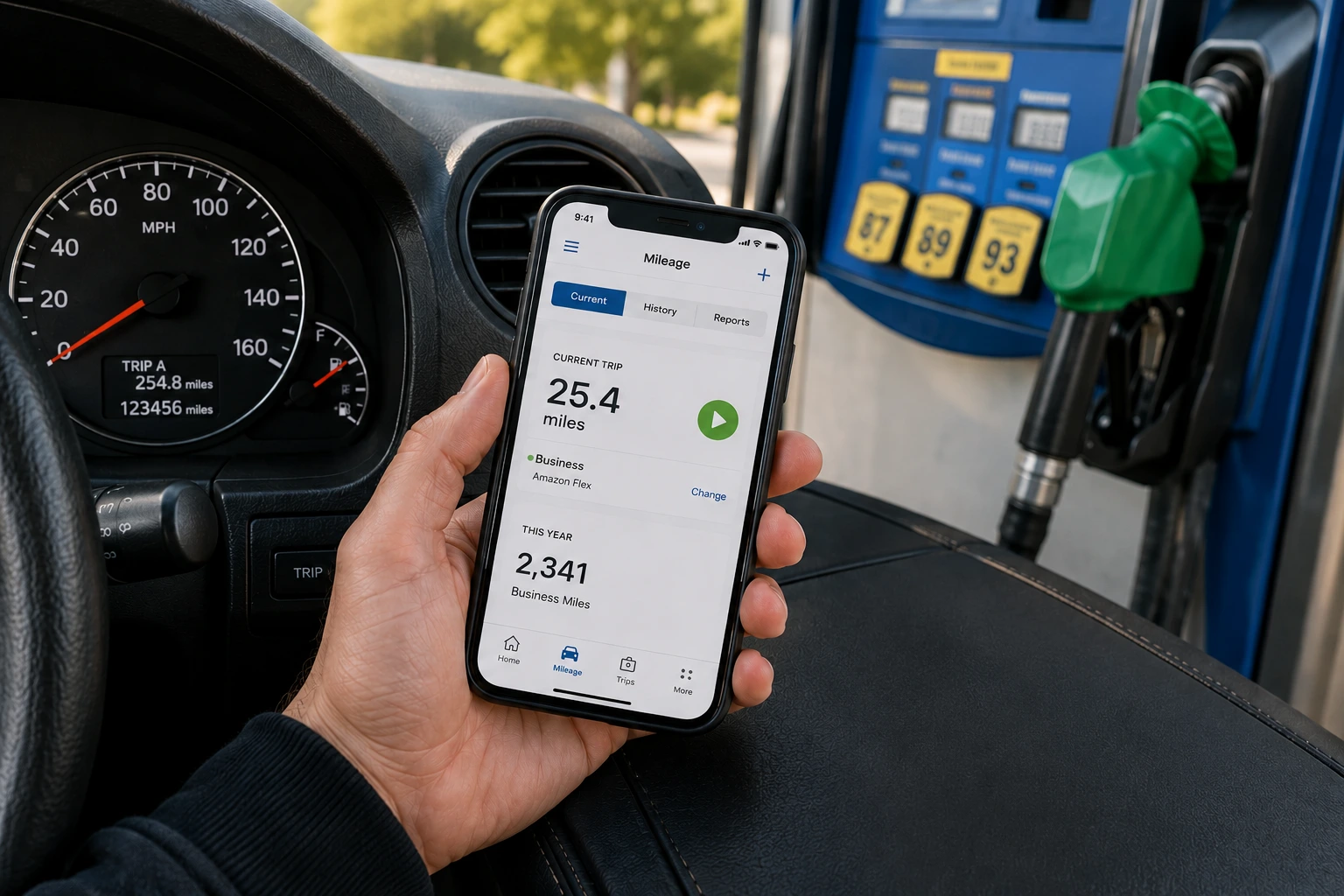
The cleanest way to value that cost is the IRS standard mileage rate, which Flex drivers can also use to deduct vehicle expenses at tax time. The IRS set the 2026 business rate at 72.5 cents per mile through 30 June, then raised it to 76 cents per mile from 1 July through 31 December 2026 as fuel costs climbed. For blocks driven in the second half of 2026, 76 cents is the rate to use. It bundles fuel, maintenance, and depreciation into one number you multiply by your route miles.
What comes out of your own pocket:
- Fuel for every mile you drive
- Tolls and parking on the route
- Maintenance, tires, and depreciation
- Self-employment tax on your net earnings
Flex income is self-employment income, so you owe self-employment tax of 15.3% on your net, plus regular income tax. It's smart to set aside 25% to 30% of your earnings for taxes and to make quarterly estimated payments. Keep a mileage log, as IRS Publication 463 requires, because every mile is deductible and the total mounts quickly across a week of blocks.
A worked take-home example for a 3-hour block
Start with the gross. A three-hour block at the $20.89 median pays about $63 before anything comes out. Then subtract the vehicle cost at the 76-cent rate:
- Gross block pay: $63 for three hours
- Route miles: 40 miles driven
- Vehicle cost: 40 × $0.76 = about $30
- Net after vehicle cost: $63 − $30 = about $33, or roughly $11 an hour
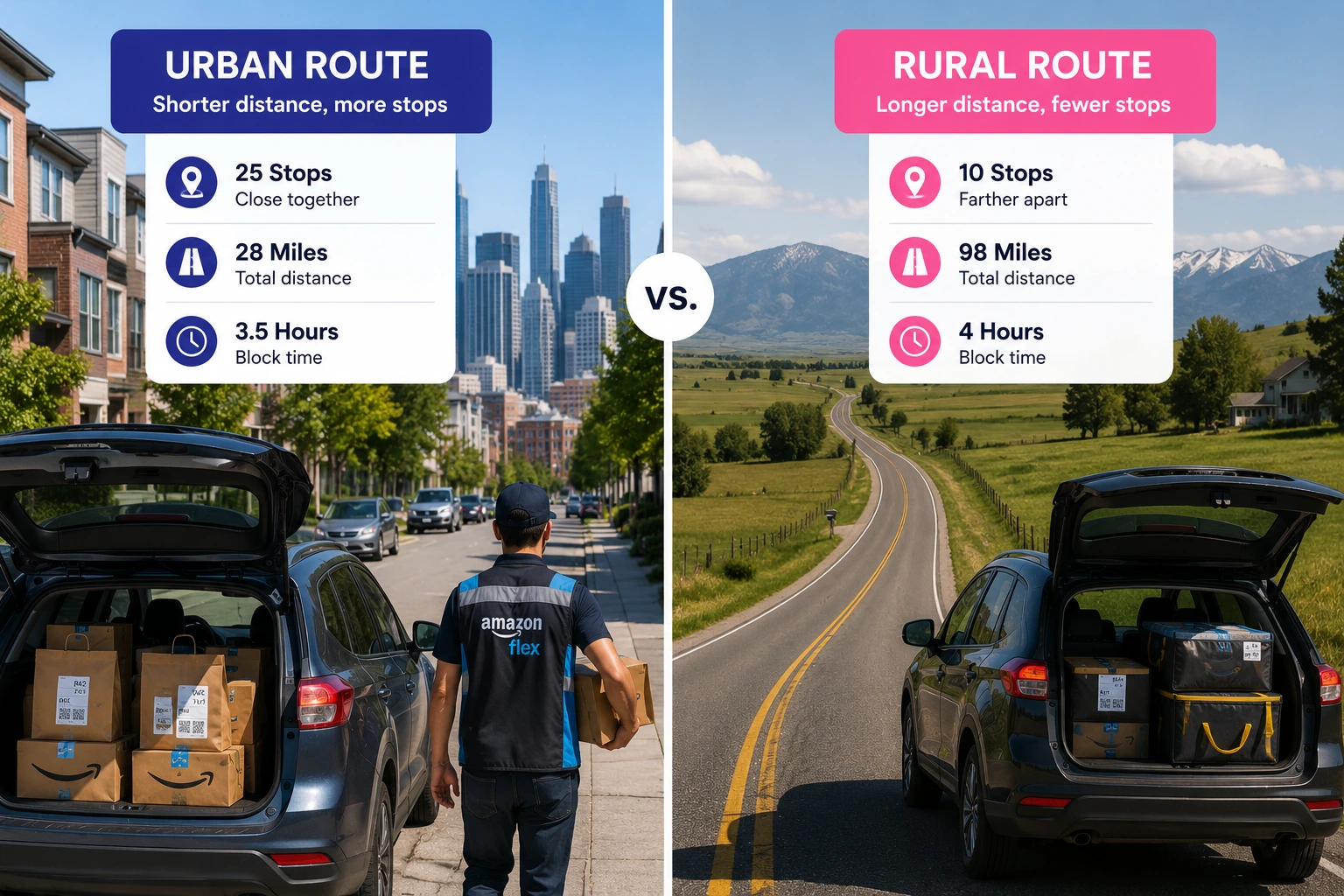
A lighter route changes the answer a lot. Drive only 25 miles and the vehicle cost drops to about $19, leaving roughly $44, or close to $15 an hour. Tight urban routes protect your effective hourly far better than long rural ones, even when the headline pay is identical.
Tax is a separate reduction. The mileage deduction softens it, but not dollar-for-dollar. Deducting 40 miles at 76 cents removes about $30 from your taxable income, which saves the tax on that $30 rather than handing back the $30 itself. Your cash take-home stays in the $11 to $15 range on a typical route.
Amazon Flex pay by city and state
Where you drive shifts the rate by a dollar or two an hour, and high-demand metros post the highest figures. The estimates below come from ZipRecruiter's job-posting data, which pools Flex and similar driver roles, so read them as a regional guide rather than tracked Flex-only pay.
| Area | Average annual | Approx. hourly | Top 10% |
|---|---|---|---|
| US average | $38,383 | $18.45 | $49,000 |
| New York | $41,993 | $20.19 | $53,607 |
| California | $37,881 | $18.21 | $48,358 |
By state, ZipRecruiter ranks Washington highest, with the District of Columbia and New York close behind. New York runs about 9% above the national average. Drivers on r/AmazonFlexDrivers report weekly totals that track the same pattern, roughly $600 to $700 a week in Los Angeles, $1,000 to $1,500 in New York City, and peaks around $1,600 in Boston during busy periods. Those are gross, driver-reported figures before expenses.
How much Amazon Flex drivers make per year
How many blocks you secure changes the annual total far more than the hourly rate does, which is why two drivers on the same quoted rate can finish the year thousands of dollars apart.
At full-time-equivalent hours, Gridwise's data points to about $836 a week and roughly $43,450 a year gross, or about $32,000 to $40,000 net after expenses. ZipRecruiter's job-posting average is lower at $38,383 a year, with most estimates between $33,500 and $42,000 and the top 10% near $49,000. Full-timers on Reddit report the high end only in dense metros with steady block availability. Most drivers work well below full time, so real annual totals vary widely.
Best times to drive Amazon Flex and how to earn more
Blocks are released in batches through the day rather than all at once, and the higher-paying ones go fast. A few habits protect your effective hourly:
- Grab surge windows. Increased-rate blocks add $5 to $20; mornings and peak evenings tend to pay more.
- Favour grocery and store blocks when tips matter, since logistics blocks rarely tip.
- Take tight urban routes over long rural ones to cut fuel and mileage per dollar earned.
- Drive a fuel-efficient car, since gas is your biggest variable cost.
- Log every mile for the 76-cent deduction, and check the app early when blocks drop.
Experienced drivers on r/AmazonFlexDrivers add one rule of thumb. Don't start with a late evening block, since traffic and returns can drag a good rate down.
Who can drive for Amazon Flex, and the waitlist
Availability is the first gate, and for many drivers it closes before pay ever matters. To sign up you generally need to be 21 or older, hold a valid US driver's license and a Social Security number, have an eligible midsize-or-larger vehicle with insurance, and use a compatible smartphone.
Meeting the requirements doesn't guarantee a spot. Every delivery station caps how many active drivers it can hold and only opens slots when a driver leaves, so approval can take anywhere from a few days to over a year. In the largest metros, drivers report multi-year waitlists, and a busy station can sit closed for months even as delivery demand climbs. Checking the app for your zip code is the only reliable way to see whether a slot is open right now.
If the waitlist rules you out, it's worth looking at earning paths that start today. You can make money online without a fixed schedule instead of waiting for a station to open a slot. EarnStar is one no-waitlist option, paying cash for playing mobile games and completing surveys, with cashout from $5 and no vehicle required.
Amazon Flex vs other delivery and shopping apps
Flex trades flexibility for predictability. You schedule a block and see its pay upfront, whereas DoorDash, Instacart, and Uber Eats send per-order offers that swing with live demand. The upfront number is easier to plan around, but it locks you into a fixed window once you accept.
On tracked median pay, Flex sits mid-pack among gig apps:
| App | Median hourly (Gridwise 2025) |
|---|---|
| Walmart Spark | $21.74 |
| Uber | $21.18 |
| Amazon Flex | $20.89 |
| Uber Eats | $14.07 |
| DoorDash | $11.26 |
| Factor | Amazon Flex | Per-order apps |
|---|---|---|
| Pay visibility | Shown before you accept the block | Varies per offer |
| Scheduling | Reserved blocks | On-demand, log in anytime |
| Tips | Only on eligible orders | Standard on most orders |
| Payout speed | Twice weekly, plus Instant Pay | Often same-day cashout |
Drivers who want faster payouts than Flex's scheduled blocks can compare gig apps that pay same day before committing to a station waitlist.
Is Amazon Flex worth it in 2026?
Amazon Flex pays a predictable $18 to $25 per quoted hour and a tracked median near $20 to $21, but take-home after vehicle costs lands closer to $11 to $15 an hour on a typical route. That makes it solid as flexible income and weaker as a full wage.
The waitlist is the catch most new drivers hit first. If a station near you is capped, the pay math never gets a chance to play out, which is why availability deserves a check before anything else.
- Good fit: you own a fuel-efficient car, drive tight urban routes, and want set hours
- Poor fit: you face long rural routes, a multi-year waitlist, or need every dollar to count as wage
For readers who want flexible earning without a vehicle, fuel costs, or a waitlist, EarnStar pays cash for mobile games and surveys, with cashout from $5.
Amazon Flex pay: common questions


Start earning on EarnStar with no deposit needed
Free to join, $1 PayPal cashout, 100+ games and surveys in one app. Your first payout can land before the end of the week.