
You're three shifts deep, your scrubs still smell like alcohol gel, and you're scrolling for side hustles for nurses that don't ask you to clock back in. That's the whole problem with most "nurse side hustle" lists: they hand you another shift in a different uniform.
About 54% of Americans now run some kind of extra income stream, and with the median RN salary sitting at $93,600, most nurses aren't desperately chasing rent money. They're looking for flexible income that doesn't completely drain what little recovery time they have left.
EarnStar is the zero-clinical-thinking option in this guide: open the app on the couch after a 12-hour shift, play games you'd already play anyway, and turn some of that downtime into extra cash or gift cards.
Here's what you'll get below:
- 12 hustles ranked by effort and credential load (no MLMs, no upfront-fee programs)
- An at-a-glance comparison table so you can scan in 30 seconds
- A real income-stacking example with realistic monthly numbers
How we picked these side hustles for nurses
The bar for getting on this list of side hustles for nurses was simple: a working nurse on a 3x12 schedule should be able to start within the week, without paying for the privilege, and without violating scope of practice.
We cross-checked earnings ranges against BLS, NurseJournal, and TrustedHealth. Any stat older than 2024 is flagged as "trend has held but worth a fresh check."
We sorted the list by effort and credential load so Tier 1 is start-tonight and Tier 4 is build-a-business.
Our criteria:
- Low setup time (Tier 1: under an hour from download to first task)
- No new credentials required in Tier 1
- Real cash-out in dollars or gift cards, not points or sweepstakes
- Schedule-compatible with 3x12 rotations and recovery days
- Scope-of-practice safe (nothing asks you to practice outside your license)
We did not include: MLM nurse "opportunities," upfront-fee training programs, token-only platforms, or sweepstakes-only payouts.
The skeptic's quick check further down gives you a 3-trait filter to run on anything new you find.
Compare all 12 side hustles at a glance
Scan the "credential needed" column first if you're starting this week. Scan "time to first dollar" if you need cash by next payday.
| Hustle | Credential needed | Typical earnings | Time to first dollar | Effort |
|---|---|---|---|---|
| EarnStar | None | Near-passive idle-time earnings (varies) | Same day | Low |
| Paid medical surveys (M3 Global Research, InCrowd, All Global Circle) | Active nursing license to qualify | $1 to $50 per survey, $150 to $300 for long interviews | Within a week | Low |
| Micro-task and receipt apps (Ibotta, Fetch, Receipt Hog) | None | $20 to $80 per month | Same day | Low |
| Per diem shifts (Clipboard Health, ShiftMed, IntelyCare) | Existing license + compliance docs | $35 to $75 per hour | Within a week | Medium |
| Telehealth nursing | RN or NP, compact license preferred | $30 to $50 per hour ($60+ for NPs) | 2 to 4 weeks | Medium |
| Immunization clinics (Walgreens, CVS, seasonal pop-ups) | RN or LPN | $20 to $45 per hour | 2 to 4 weeks | Medium |
| Freelance health writing | Portfolio | $0.25 to $1 per word | 4 to 8 weeks | Medium-high |
| Legal nurse consulting | RN + chart-review experience | $100 to $150 per hour | 1 to 3 months | High |
| NCLEX and nursing school tutoring | RN, recent grad ideal | $25 to $75 per hour | 2 to 4 weeks | Medium |
| CPR and BLS instruction | AHA or Red Cross instructor course ($300 to $500) | $50 to $100 per hour | 4 to 8 weeks | Medium |
| Digital products (Gumroad, Etsy) | None | $5 to $35 per product, variable monthly | 2 to 6 weeks | High setup, low maintenance |
| Online course (Teachable, Thinkific) | None | $49 to $299 per course, variable monthly | 1 to 3 months | High setup, low maintenance |
All figures are typical ranges from public sources, not guarantees. Your numbers will vary with state, specialty, and platform.
Tier 1: zero credential, start this week
These need nothing beyond a phone and a free account. They fit the "dead time" between shifts, the hour you're too wired to sleep after a night shift, and the couch session that follows a recovery day.
No certification required. Start tonight.
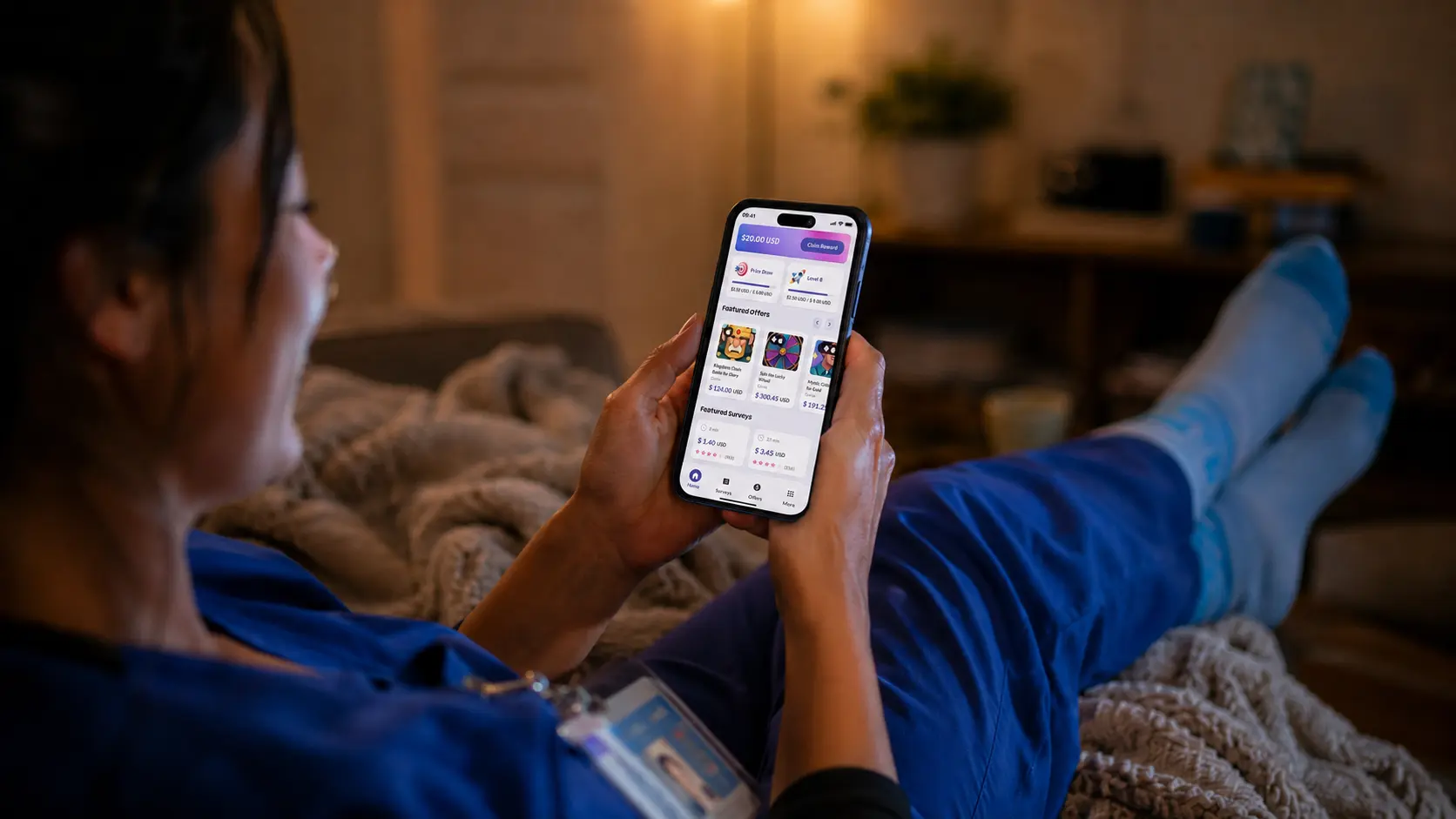
EarnStar (earn from playing games)
Open EarnStar after a 12-hour shift, play the kind of casual games you'd already pull up on the couch, and turn that idle time into PayPal cash or gift cards. No charting, no patients, no clinical thinking.
To be honest: this is near-passive idle-time earning, not a shift replacement. Inside the app you'll find a library of games, offer walls, and daily tasks.
You can earn $50 to $150 a month from casual play, and more if you steadily complete offers. EarnStar is free, has no upfront fee, no credential check, and runs on iOS and Android.
Why it fits nurses:
- Zero clinical thinking required, which matters most on recovery days
- Works during 12-hour-shift wind-down when you're too tired to read but not tired enough to sleep
- Your phone is already in your pocket, so there's nothing new to set up
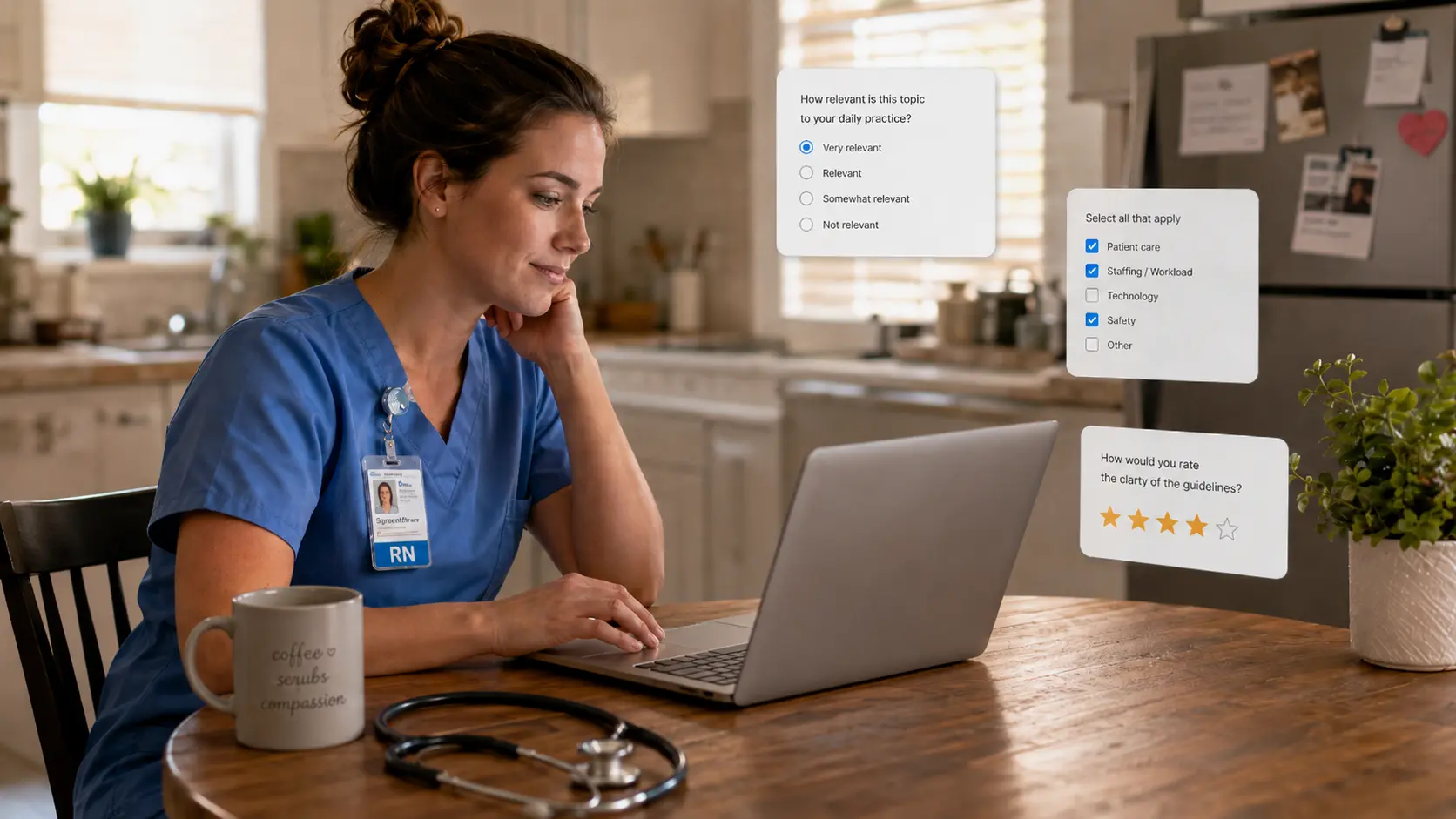
Paid medical surveys (M3 Global Research, InCrowd, All Global Circle)
Pharma and medical-research firms pay licensed nurses for structured opinions on drugs, devices, and care protocols. M3 Global Research, InCrowd, and All Global Circle are the three most established panels for U.S. nurses.
Typical pay runs $1 to $50 for short surveys and $150 to $300 for longer phone interviews, with specialty driving volume: ICU, ER, and oncology nurses tend to pull more invites than general med-surg. Time to first dollar is usually within a week of profile approval.
These platforms verify your license, but they don't require any new certification. Skip any "panel" that asks for an upfront fee or pays only in points.
Micro-task and receipt apps (your phone is already in your pocket)
This category covers cash-back and short-task apps like Ibotta, Fetch, and Receipt Hog. The model is simple: scan grocery receipts, complete short tasks, watch sponsored content, redeem for cash or gift cards.
Realistic earnings: most users see $20 to $80 a month, not rent money. Think of these as easy side hustles for nurses to run on a break-room couch, not a primary income source.
Avoid any micro-task app that requires a paid subscription to cash out. That's a red flag.
Start with the lowest-friction option in this tier. Signup to EarnStar for free and earn during tonight's wind-down.
Tier 2: low-effort clinical, use the license you already have
Tier 2 uses the license you already hold, with no new certifications. The pay is higher than Tier 1, but the trade is clinical thinking, so stack carefully on recovery days.
For context, BLS recorded 180,000+ RNs working in U.S. home healthcare as of May 2023, and per diem demand has kept climbing since. CNAs and LPNs do well with per diem and home health, RNs add telehealth and immunization clinics, and NPs unlock higher-paid telehealth visits.
License check: confirm your state board allows the platform, and confirm your employer's moonlighting policy is clear. See the contract section below.
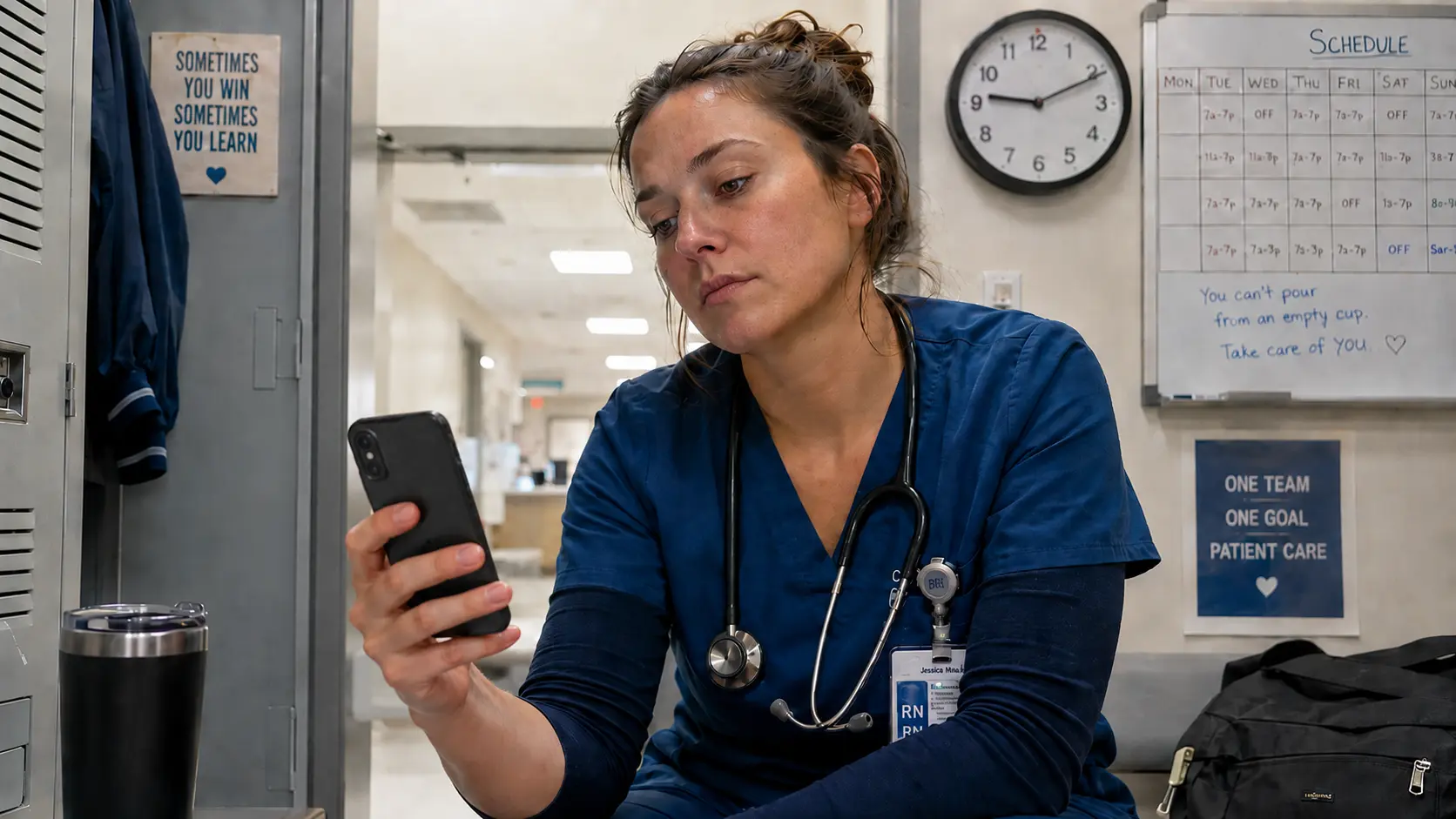
Per diem shifts via Clipboard Health, ShiftMed, and IntelyCare
The model is open shifts at nearby facilities, paid per shift, often with next-day pay. Clipboard Health, ShiftMed, and IntelyCare are the three platforms most nurses actually use.
Expect $35 to $75 per hour depending on state, specialty, and shift type (overnight and weekend pay higher). All three platforms collect your credentials and compliance documents once, then let you book shifts in-app.
Time to first dollar is within a week if your license and compliance docs are current.
The main caution: read the cancellation policy. Some platforms penalize last-minute drops, which matters when you're juggling a W-2.

Telehealth nursing
Telehealth nursing covers triage, chronic check-ins, and post-discharge follow-ups by phone or video. The lane has grown steadily since the AMA reported a sharp telehealth uptick starting in 2017 (pre-2023 data, but the trend has held).
Pay runs $30 to $50 per hour for RNs, with NPs commonly billing $60+ for visits. An active RN or NP license is required, and a multi-state compact license dramatically widens the platforms that will hire you.
Time to first dollar is usually 2 to 4 weeks once onboarding is done. Confirm whether the platform covers malpractice or expects you to carry your own.
Immunization clinics at Walgreens, CVS, and seasonal pop-ups
Immunization clinics are the "predictable side shift" option, with demand peaking around flu season and back-to-school. Walgreens, CVS, and seasonal pop-ups all hire RNs and LPNs (CNAs are not eligible for vaccine administration).
Pay typically runs $20 to $45 per hour. Some chains require a short in-house immunization training, which is not a new credential, just an orientation.
Time to first dollar is 2 to 4 weeks. The honest caution: schedules cluster in fall and winter, and off-season hours can be thin.
Tier 3: moderate effort, higher ceiling
Tier 3 requires some setup, like a writing portfolio, a tutoring profile, a consulting one-pager, or an instructor course. The reward is a higher per-hour ceiling, and three of the four options are fully location-independent.
This tier rewards specialty knowledge. ICU, ER, peds, and oncology nurses charge premium rates in both writing and consulting because attorneys and editors pay more for clinical depth.
Freelance health writing
Freelance health writing is one of the most flexible side hustle ideas for nurses with a strong clinical voice: blog posts, patient education content, continuing education articles, and clinical white papers for hospitals, agencies, and digital health brands.
Entry-level posts run $50 to $150 each, and once you have three to five published clips, rates climb to $0.25 to $1.00 per word. Find work on Upwork, Contena, or direct pitches to nursing publications.
Time to first dollar is 4 to 8 weeks. Skip "content mills" paying under $0.10 per word, they'll eat your evenings for almost nothing.
Legal nurse consulting
Legal nurse consultants review medical records for attorneys in malpractice, personal injury, and workers' comp cases. The work is chart-heavy, deadline-driven, and well-paid: $100 to $150 per hour is standard.
The CLNC credential is optional, not required. Many attorneys hire RNs with strong chart-review experience and good writing instead.
Time to first dollar is typically 1 to 3 months. This is the highest-ceiling option in Tier 3 and also the slowest ramp, so treat your first 6 months as marketing: cold emails to local firms, a clean one-page site, and a sample chart-review summary.
NCLEX and nursing school tutoring
If you graduated within the last 5 years, you can teach what you just lived through. Newer RNs often out-earn senior nurses here because the material is fresh.
Find students on Wyzant, Varsity Tutors, or by direct outreach to local nursing programs. Pay runs $25 to $75 per hour, with NCLEX prep and specialty review at the top of that range.
Time to first dollar is 2 to 4 weeks. Demand peaks March to May and October to December, mapped to NCLEX testing waves.
CPR and BLS instruction
CPR and BLS instructors run certification classes for hospitals, gyms, daycares, and corporate clients. The credentials come from the American Heart Association (BLS instructor) or American Red Cross (instructor course).
This is the one Tier 3 option with a real upfront cost: the instructor course runs 2 to 3 days and $300 to $500. Once certified, pay is $50 to $100 per hour, often billed per class rather than per hour.
Time to first dollar is 4 to 8 weeks. Factor in equipment (manikins, AED trainers), or partner with a training site that already owns the gear.
Tier 4: passive and business-side ideas
Tier 4 is where real side business ideas for nurses live.
Be honest with yourself: month one is unpaid setup, month three is small wins, and month twelve is where compounding shows up. Reserve the word "passive" for things that actually keep paying after the work stops, like a finished course or a digital product that sells overnight.
Sell digital products on Gumroad or Etsy
Nurses sell well in a few specific niches: patient education printables, nursing study planners, NCLEX cheat sheets, preceptor handoff templates, and new-nurse onboarding workbooks. Pricing runs $5 to $35 per product.
Gumroad has lower fees and a simpler setup. Etsy gives you more discoverability from inside the platform.
Time to first dollar is 2 to 6 weeks once a product is live. The hard rule: never share copyrighted hospital materials or anything traceable to a specific employer.
Build an online course on Teachable or Thinkific
A recorded course is built once and sold repeatedly. Strong topics for nurse creators include NCLEX prep, new-grad survival, charting efficiency, and specialty primers (telemetry, ICU, ER).
Pricing runs $49 to $299 per course depending on depth and audience. Time to first dollar is 1 to 3 months for a first launch, longer if you're starting an audience from zero.
A low-priced course needs steady traffic to make sense. A higher-priced cohort-style course can launch successfully with a small but engaged email list.
Nurse coaching or health coaching as a small business
Coaching covers 1-on-1 work for chronic conditions, weight management, post-discharge recovery, or new-nurse first-year navigation. Pricing runs $75 to $200 per session, with package pricing more common than single sessions.
This is not the same as licensed clinical care. Spell out scope clearly in a client agreement so you're coaching, not practicing.
This is the most "build a business" option on the list. Treat it like a small business from day one (an LLC is optional, not the urgent first step despite what some competing articles claim).
Skeptic's quick check: does this side hustle actually pay?
Nurses get pitched a lot of bad opportunities, including low-pay scams, MLM "wellness" recruitment, and "courses" that exist mostly to upsell more courses. Run any new platform through this three-trait filter before you sign up.
- Real cash-out: the platform pays in dollars or gift cards, not just points or sweepstakes entries.
- No upfront fee: you never pay to start. Optional certifications are different, and they should be your choice, not a gatekeeper.
- Scope-of-practice compatible: nothing on the platform asks you to practice outside your license or your state.
If something fails any of these, close the tab. There are too many viable side income options available online to sign up for something even a bit risky.
What about your contract, malpractice, and taxes?
The boring stuff matters more than the earnings math. A missed moonlighting clause or a skipped 1099 will erase a year of side income faster than any payout schedule will rebuild it.
$600 rule: once any platform pays you $600+ in a year, expect a 1099-NEC. Track every payout from day one.
Moonlighting clauses
Most hospital contracts restrict outside clinical work at competing facilities, and some restrict any paid clinical work without written approval. That's the part that catches nurses by surprise.
What's usually fine: non-clinical writing, NCLEX tutoring, app-based income like EarnStar, and digital products. Before you pick up per diem at a competing system, ask HR or re-read your contract.
Malpractice and professional liability insurance
Clinical side gigs (per diem, telehealth, immunization clinics) usually require coverage. Confirm whether the platform provides it (Clipboard Health, ShiftMed, and IntelyCare typically do, telehealth platforms vary), or carry your own through NSO or a similar provider.
Non-clinical work (writing, tutoring, app-based income, digital products) doesn't require malpractice coverage.
Self-employment taxes in plain English
Anything outside your W-2 is self-employment income, and it goes on Schedule C. Set aside roughly 25% to 30% of your net side hustle income for federal taxes.
Check your state's quarterly estimated payment requirements, because penalties for missing those quarters add up fast.
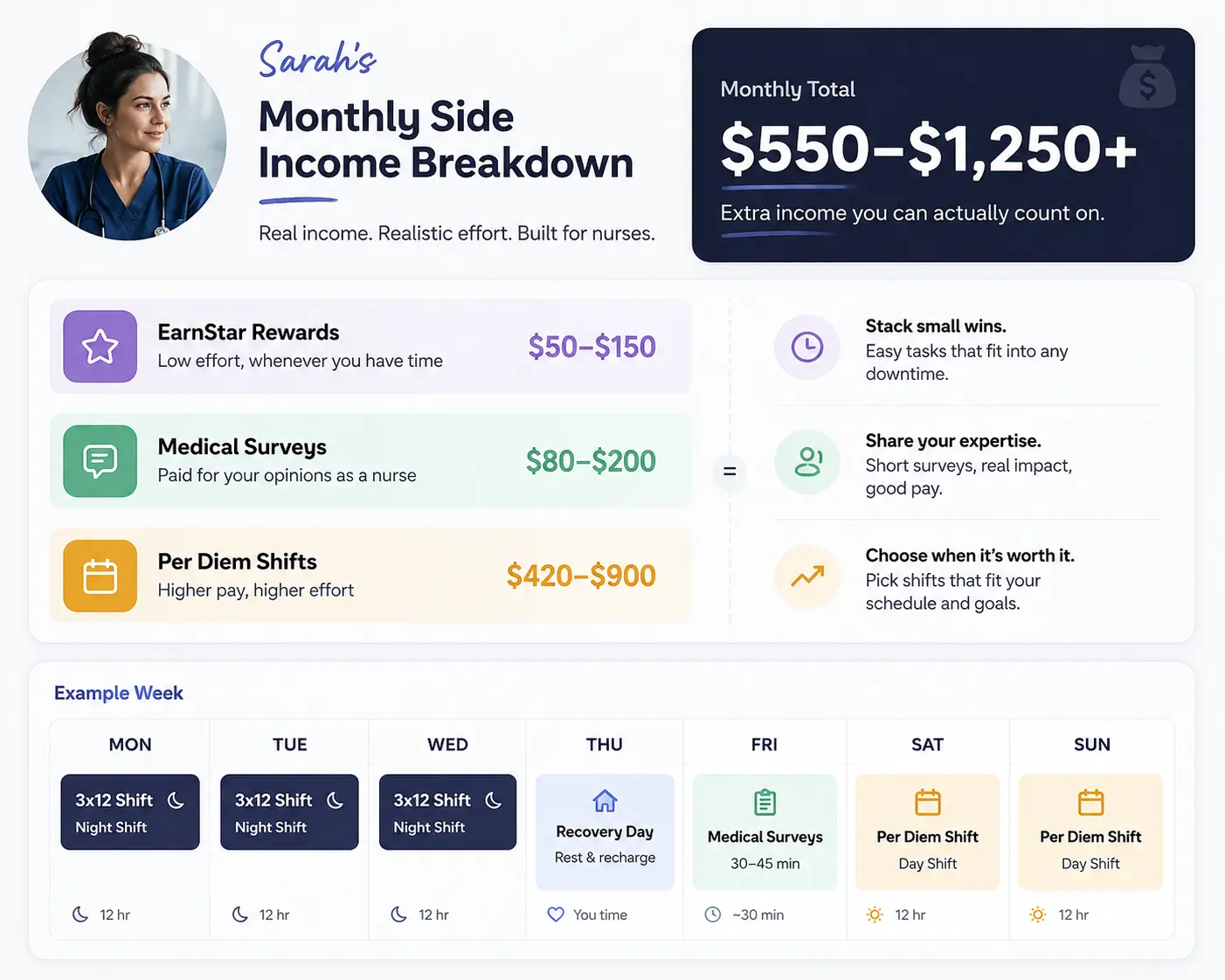
Nurse income stack example
Meet Sarah, an ICU RN with three years of experience, working full-time at a city hospital on a 3x12 rotation.
These are realistic numbers for a nurse in her position, not best-case, and they're illustrative, not guaranteed.
| Source | Hours per week | Typical monthly | Notes |
|---|---|---|---|
| EarnStar (idle-time, post-shift) | ~3 | $50 to $150 | Near-passive, couch-time |
| Paid medical surveys (M3 Global Research, InCrowd) | ~2 | $80 to $200 | ICU specialty pulls more invites |
| Per diem via Clipboard Health (one shift twice a month) | ~6 | $420 to $900 | $35 to $75 per hour |
| Total | ~11 | $550 to $1,250+ | Realistic stack, not best case |
Sarah's week looks like this: Monday through Wednesday she's on her 3x12 at the hospital. Thursday is a hard recovery day on the couch with EarnStar running while she watches TV.
Friday she knocks out a couple of medical surveys during her kids' nap window, and she picks up a per diem shift on a Saturday twice a month.
Swap the per diem for legal nurse consulting or freelance health writing as the ceiling rises and Tier 3 starts pulling weight.
Other earning apps to try alongside EarnStar
EarnStar is the anchor for this list, but stacking two or three earning apps is how most users hit a real monthly number. Here are five worth running in parallel.
- PaidTester: get paid to test apps and websites. Best for users who want non-gaming earning options.
- TopSurveys: survey-focused platform with low disqualification rates. Best for users frustrated with other survey sites.
Each one is its own platform with its own offer pipeline, so try one alongside your base layer rather than stacking three at once.
Pick one side hustle, then stack a second
The fastest way to burn out is to try all 12 at once. Pick one Tier 1 option you can start tonight, run it for a few weeks until it feels routine, then layer a Tier 2 or Tier 3 option that fits your license and schedule.
Before anything clinical, run the contract and tax checklist above. Your moonlighting clause, malpractice coverage, and the 1099 threshold matter more than any single payout on this list of side hustles for nurses. Start tonight with the lowest-friction option in this guide.
FAQs about side hustles on a nurse's schedule
Get quick answers on nurse side hustles, realistic earnings, taxes, moonlighting rules, malpractice concerns, and which options actually fit around a 3x12 schedule.


Start earning now
Turn the time you already spend playing into real cash and gift cards, with simple tasks, clear milestones, and fast withdrawals when you're ready.