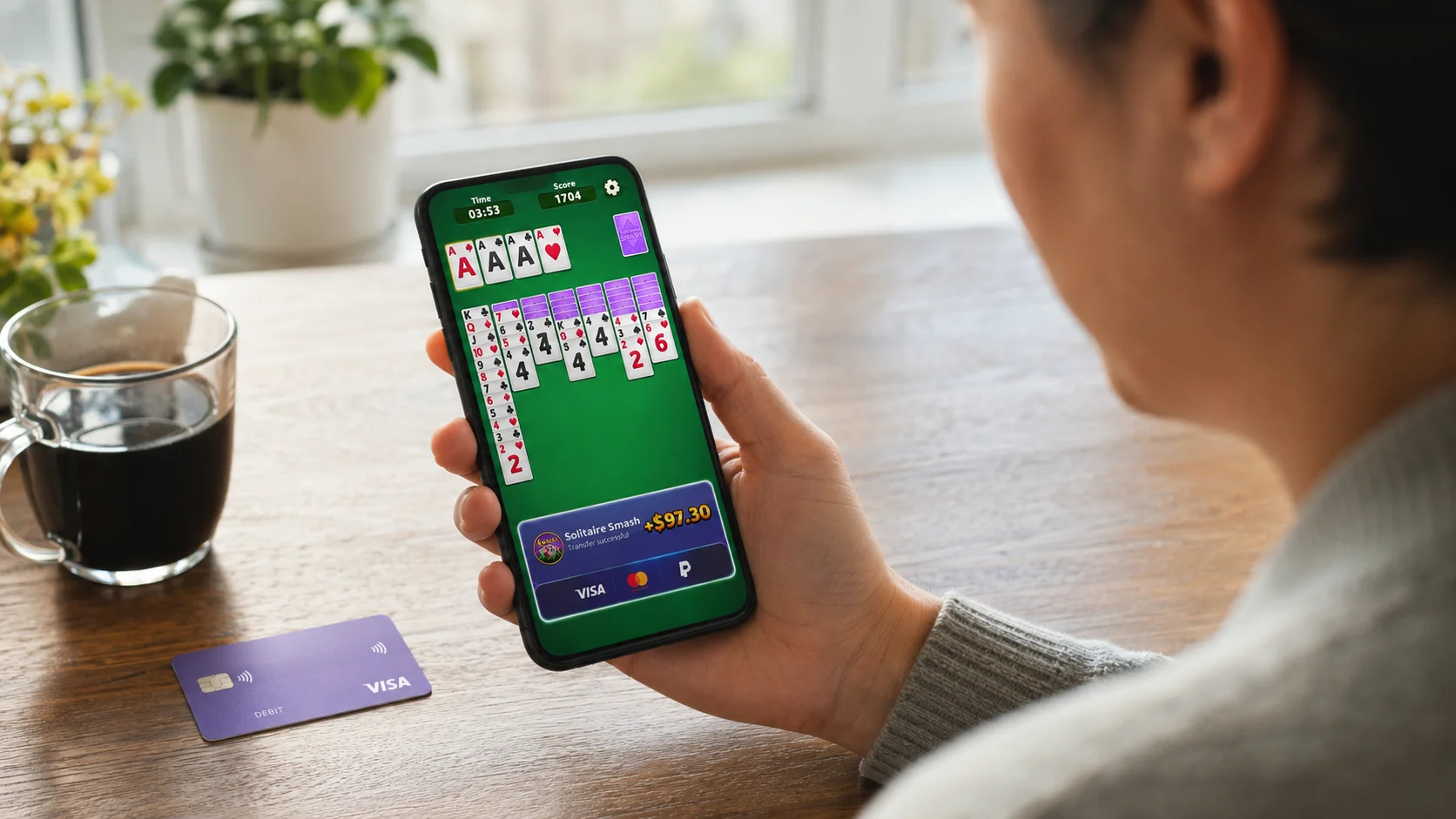
If you are looking for a real strategy for Solitaire Cash, the first thing to understand is what actually drives results. This is not just about playing faster or getting lucky on a single hand. Over time, your win rate, your score, and your earnings are shaped by how you play.
Small decisions stack. The way you manage the board, how you approach scoring, and when you enter higher stakes all make a difference. This guide breaks down the scoring system, how skill shows up in real matches, and the mistakes that quietly drain money from otherwise solid players.
Building a side-income habit around games? EarnStar pulls a wider library of paying games into a single app.
Is Solitaire Cash skill or luck?
Before getting into the best strategy for Solitaire Cash, let’s answer the question every income-minded player asks first. Is this skill or luck?
The honest answer is both. Every deal has some randomness built in, and any single hand can go either way. Over a session, though, your win rate, your final score, and your earnings move with skill in a way that is hard to ignore.
Research suggests strategy gameplay produces a moderate cognitive gain. A meta-analysis of 63 studies found an effect size around g = 0.25, with measurable transfer to attention, perception, and higher-order thinking. That does not promise you will cash out more this week, but it supports what consistent players already feel. The reps add up.
There is also a structural reason skill matters in this app. Solitaire Cash matches you against another player on the same deal. You are not racing the deck. You are competing against a person who received the exact same cards.
The player who scores faster and higher takes the entry pool. That is where strategy compounds, because two players on identical cards rarely play them the same way.
How the best strategy for Solitaire Cash actually works
The best strategy for Solitaire Cash is whatever maximizes your point total in the time you have. The clock is real, the opponent is real, and your score, not your “win,” is what gets paid.
Three levers move that score:
- Speed: Finishing faster leaves more time for combo plays, and time bonuses are points in their own right.
- Move efficiency: Every face-down card you reveal opens new legal moves and scoring opportunities.
- Time-bonus capture: The reward curve for finishing under a threshold is steep, so a deal solved in 90 seconds often pays much better than the same deal solved in 140.
That’s the divergence from casual Klondike, where there is no clock, no opponent, and no entry fee. In Solitaire Cash all three are doing work on every hand.
Solitaire Cash is developed by Papaya Gaming and is available on iOS and Android only.
Cash game features depend on local skill game regulations, so availability varies by U.S. state. Always check whether cash play is supported where you live before depositing.
How scoring works in Solitaire Cash (and how to get a high score)
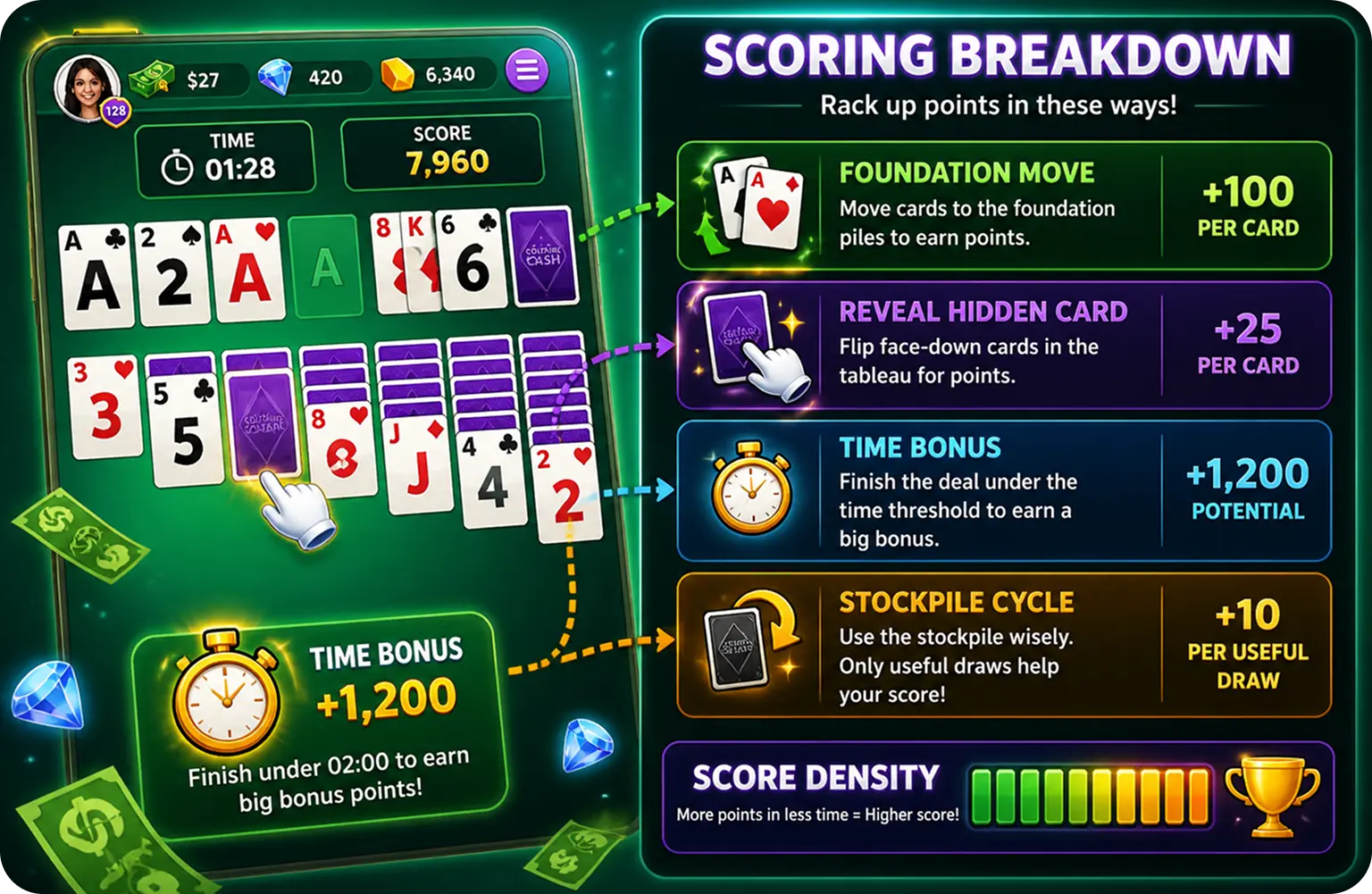
To get a high score on Solitaire Cash, prioritize foundation moves once an ace is up, reveal face-down tableau cards as fast as possible to unlock more legal moves, and treat the timer as a scoring lever rather than a backdrop. Time bonuses are points, and decisive tapping beats hovering on every deal. Exact point values can shift between modes and updates, so confirm current numbers in the in-app rules screen.
Scoring in this app is built from a few stacked components: points for moving cards to the foundation piles, points for revealing face-down tableau cards, time-based bonuses for finishing under certain thresholds, and in some modes, combo or streak weighting on rapid plays.
| Move type | What it scores | Why it matters | Action you should take |
|---|---|---|---|
| Foundation move | Points per card moved up to a foundation | Foundations are the densest scoring area on the board | Send cards up the moment they're available, unless it strands a needed card below |
| Reveal face-down card | Points for each tableau card flipped | Hidden cards block legal moves; revealing them unlocks score | Prioritize columns with the most face-down cards underneath |
| Time bonus | Bonus points (or value) for finishing under a threshold | Clock time directly converts to score | Tap with intent, plan the next move while executing the current one |
| Stockpile cycle | Points (or none) per useful draw, depending on mode | Idle cycling burns clock without paying | Cycle only when you have a known winning move waiting on a draw |
Exact point values vary by game mode and update; check the in-app rules screen for the latest.
Every line in that table is a behavior change in disguise. Don't park aces and twos in the tableau, hesitation is expensive in cash modes, and revealing hidden cards unlocks more legal moves per second. A clean game that finishes slow can lose to a messier game that finishes fast, which is why the tactics below all aim at score density rather than tidy boards.
How to get more points in Solitaire Cash on every deal
A short, repeatable list of score-density tactics that work on almost any board:
- Prioritize foundation plays the moment an ace or two is exposed.
- Never break a useful tableau sequence to chase one stockpile card.
- Cycle the stockpile only when there's a known winning move waiting.
- Tap with intent. Double-taps and stray pokes cost milliseconds, and milliseconds compound across a 2-minute deal.
- Use the undo button strategically when the app allows it, especially to recover a foundation move that locked out a needed run.
- Watch for column rebuilds. An empty column you can fill with a King unlocks a long downstream sequence.
- Plan the next move while finishing the current one.
On a touchscreen, tap accuracy directly converts to score. Players who use both thumbs and tap with intent typically out-score players who hover with one finger and second-guess every move. Following proven tactics like these can help you maximize your earnings.
Beginner tips and tricks for winning Solitaire Cash
If you've just downloaded the app, the most important tips and tricks for winning Solitaire Cash are the habits you build before you ever tap a real-money entry. The skill you bring to your first paid match is the skill the app charges you to demonstrate, so practice it for free first.
Start with practice rounds until you can clear deals comfortably
Start with the practice rounds until you can clear most deals comfortably. "Comfortably" means you finish under the time threshold, not that you eventually solve it. The cash format is graded on speed and points, so a slow win in practice would be a loss against a competent opponent.
Learn the interface until it is automatic
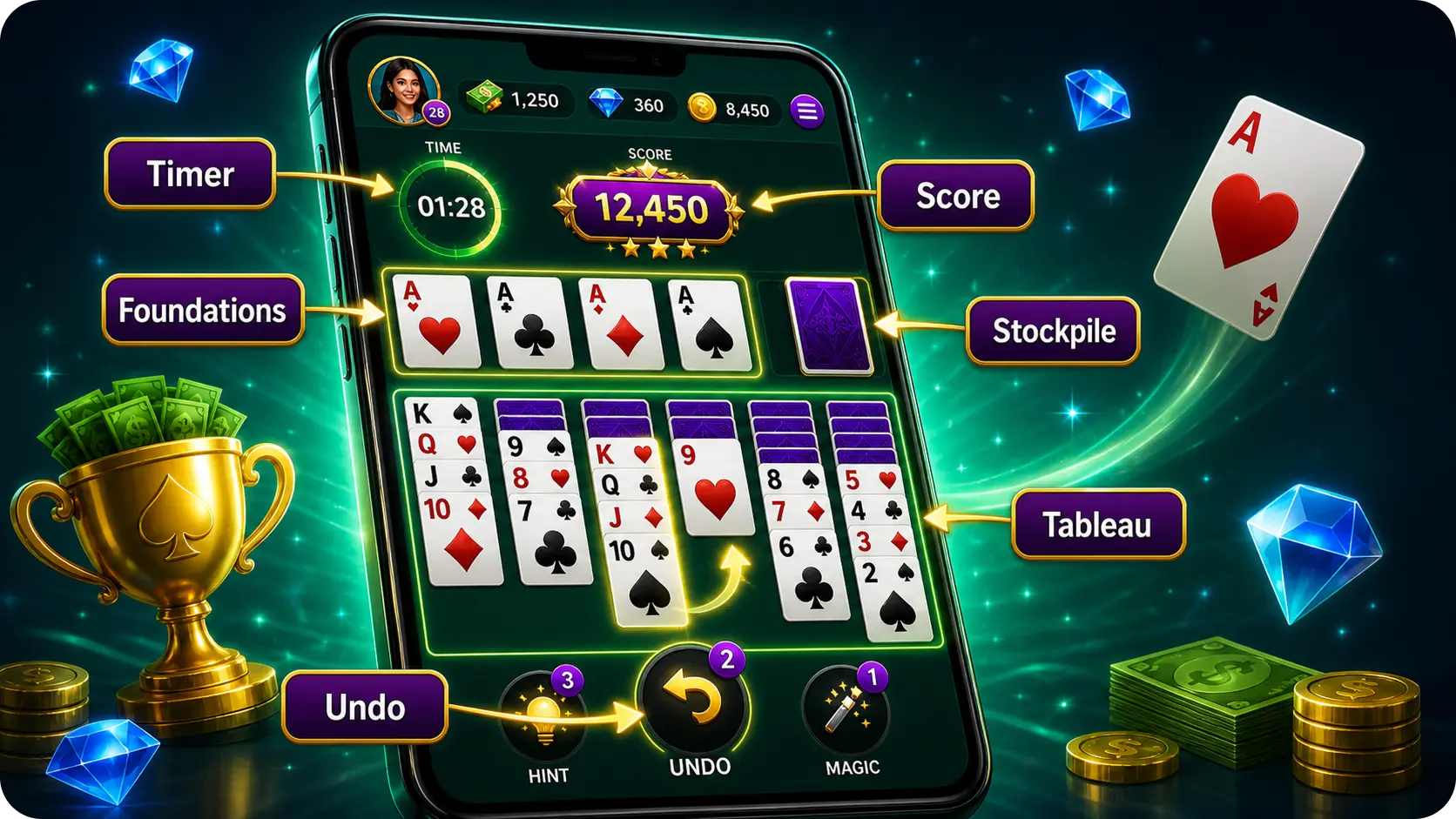
Learn the interface in your hands. Know exactly where the stockpile sits, where the foundations live, where the timer ticks, and where the undo button is. Hunting for buttons during a 2-minute hand is score you'll never get back.
Build the right move-priority instincts early
Build the right move-priority instincts early. Reveal face-down tableau cards before shuffling visible cards around. Send cards to foundations only when it does not strand a card you will need later. Watch your timer like a stopwatch, because the clock is one of your scoring inputs, not just a deadline.
Stay at low stakes until you are consistently profitable
One last beginner habit: stay at the lowest cash tier or in practice mode until your win rate on free or low-stakes deals is consistently above break-even. Stepping up before that is paying tuition you do not have to pay.
Practice mode is free, ranked is not
Practice rounds are training reps, not throwaway play. Set a personal benchmark, like a target score you can hit on most deals, and don't risk entry fees until you're hitting it without grinding. A few hours of free practice protects every cash session that follows, which is the cleanest ROI you'll get inside the app.
Intermediate strategy: speed, sequencing, and reading the deal
You can clear most deals. You're not winning consistently in cash matches. The gap between those two skill points is almost always speed, sequencing, and how early you read the board.
Speed: remove hesitation, not control
Speed first. Decisive taps beat fast taps, and hovering is where the clock disappears. The intermediate habit to build is planning the next move while executing the current one, so your hands are never waiting on your eyes. Steady tempo wins more often than frantic tapping, because frantic tapping creates misclicks that cost score and time in the same motion.
Sequencing: build longer runs, make fewer decisions
In the tableau, color alternation lets you build longer movable runs, and longer runs feed combo opportunities and let you reposition multiple cards in a single decision. Short, fragmented columns force many small choices, which is slower and lower scoring than fewer big ones.
Reading the deal: triage before you play
Reading the deal early is the most underrated skill at this tier. In the first 5 to 10 seconds, scan the layout for blocking cards, choke points, and which columns have the deepest face down stacks. You are not solving the board yet, you are triaging it. Players who triage rarely get surprised mid game.
Forfeit discipline: protect your bankroll
Forfeit discipline matters too. In modes that allow it, walking away from a clearly losing line preserves time and entry fee budget for the next hand. That is a cash decision, not a pride decision.
Mental control: stay steady under pressure
One last note on the mental side. Your opponent is working the same deal, so panic does not change the cards, it just slows your taps. Steady tempo beats speed up and unravel on every tough hand.
A note on Papaya Solitaire Cash (same app, different name)
If you've seen the game referred to as Papaya Solitaire Cash, that's the same app. Solitaire Cash is published by Papaya Gaming, so some players and search results use the developer's name. Every strategy in this guide applies identically, regardless of which name surfaces in your feed.
Advanced strategy: tournaments, head-to-head, and the unwinnable deal
Tier 3 is for players who already win consistently in single-match cash games and want to push into tournaments and higher stakes. The strategy here is not new tricks; it's adjustments to how you pace, how you read the field, and when you walk away.

Tournament pacing: play for survival early, ceiling late
Tournament pacing is its own skill. Early rounds are about clearing efficiently, not chasing a personal best, because survival into later rounds is the goal. In round one, take the safe foundation line and bank a clean finish. Late rounds flip the math. Your score ceiling matters more than your floor, so a riskier high-score line tends to beat a safe low-score line, even when it loses occasionally. In the final, send the King side stack even if it risks a stall.
Head-to-head adjustments: model the opponent
Head to head adjustments come next. You do not see your opponent's board, but you can model their likely score by how cleanly the deal solves. If the deal is generous, assume your opponent is also banking score, so pace becomes the win condition, not points alone. If the deal is gnarly, the win often goes to whoever stays calm and cycles cleanly while both boards bleed clock.
Unwinnable deals: know when to cut losses
Unwinnable deal recognition is the most expensive skill to ignore at this tier. Some deals are mathematically dead the moment they are dealt, with blocking patterns no sequence can resolve in time. In formats that allow forfeiture or early exit, knowing when to cut losses preserves both clock and entry fee.
Long-run edge: where profit actually shows up
Skill at this tier compounds. A 2 point per deal edge is invisible in any single match and decisive across a hundred. That is where session ROI starts to look more like a curve and less like a coin flip.
Stake selection and bankroll: matching skill to entry fee
Stake selection is where most "Is this worth my time?" questions actually get answered. Pick wrong, and skill stops paying. Pick right, and the same skill earns more per hour.

The pattern to know: lower stakes draw larger, less skilled player pools, so a competent player can post a higher win rate against the field. Higher stakes draw tighter pools, where margins compress and your edge has to be bigger to keep paying. Jumping stakes too early is the most common bankroll mistake in the app.
A simple rule works for most players. Stay at a stake until your win rate over 20 to 30 matches is comfortably above break-even, then step up with a small bankroll bump. Step back down without ego if a higher tier punishes you over a similar sample.
| Skill signal | Recommended stake tier | Why |
|---|---|---|
| New to the app, still using practice mode | Free or lowest cash tier | Build a baseline win rate before risking real entries |
| Consistent wins at lowest tier over 20+ matches | Mid tier | Test a tougher pool with a small bankroll bump |
| Stable mid-tier win rate plus tournament experience | High tier or tournament entry | Skill premium pays off in tighter pools |
Cash-game availability varies by U.S. state, and results vary by player, so treat any tier as a window of expected outcomes, not a guarantee.
Bankroll discipline matters as much as stake selection. Set a session budget before opening the app, decide a stop-win and a stop-loss in advance, and never chase losses with bigger entries. A bad session is information, not a sign you should bet bigger to "fix it." Players who ignore stop-losses turn skill edges into break-even nights.
If you'd like more variety than one app provides while you build that bankroll discipline, a wider games library can keep your earning time productive on slow Solitaire Cash sessions.
Common mistakes that quietly cost you cash
Most players who plateau in this app aren't missing a trick. They're paying tuition to a few habits that don't look like mistakes during play but show up on the cashier screen at the end of the month.
| Don't | Do | Why it matters |
|---|---|---|
| Tap fast and fix misclicks later | Tap with intent, never twice | Misclicks on touchscreens cost score and time on every deal |
| Hoard movable cards in the tableau | Send to foundations the second it's safe | Foundation plays are the densest scoring area on the board |
| Ignore the timer until the last 20 seconds | Watch the clock as a scoring lever | Time bonuses are real points, and pacing is structural |
| Cycle the stockpile on autopilot | Cycle only when a winning move is waiting | Idle cycles burn clock without paying you back |
| Jump stakes after one good session | Step up only after 20+ matches at break-even or better | Variance fakes skill; sample size doesn't |
| Play tired, distracted, or on a bad signal | Treat the session like a focused work block | Cash play rewards sharp attention, and punishes the opposite |
Treating losses as bad luck is the meta-mistake underneath the others, because it stops you from debugging the line of play that actually cost the hand. Most "unlucky" sessions, on review, contain two or three habits the player can fix.
Putting the best strategy for Solitaire Cash into practice (and where EarnStar fits)
Pulled together, the best strategy for Solitaire Cash is short to recap. Practice the deals for free until your win rate is steady. Train score density (foundations early, hidden cards revealed fast, no idle cycling). Build speed without losing accuracy. Match your stake to your honest current skill. Hold your bankroll rules. Audit losing sessions for the two or three habits that actually caused the leak.
That's a complete playbook for one game on one app. It's also a ceiling. Solitaire Cash is one product with one game type, and skill caps come faster than most players expect. Many readers eventually plateau on per-hour earnings, not because they've stopped improving, but because they've maxed what one game can pay.

The best strategy for Solitaire Cash is the one that lifts your score per second, your win rate per session, and your discipline at the cashier, all at once. Practice the deals for free, train score density, sharpen your speed, pick stakes that match your honest skill, and audit the habits behind your losses instead of blaming the deck. Skill matters here. It just doesn't override variance on any single hand, which is exactly why bankroll rules exist.
For readers who want their game time to compound across more than one app, EarnStar pulls a full library of paying games into one place with low minimum payouts on iOS, Android, and web. Get your first payout today, sign up to EarnStar for free.
Solitaire Cash Strategy FAQ
Quick answers to the most common questions about Solitaire Cash strategy, scoring, and real money play.


Ready to start earning?
Turn the time you already spend playing into real cash and gift cards, with simple tasks, clear milestones, and fast withdrawals when you're ready.