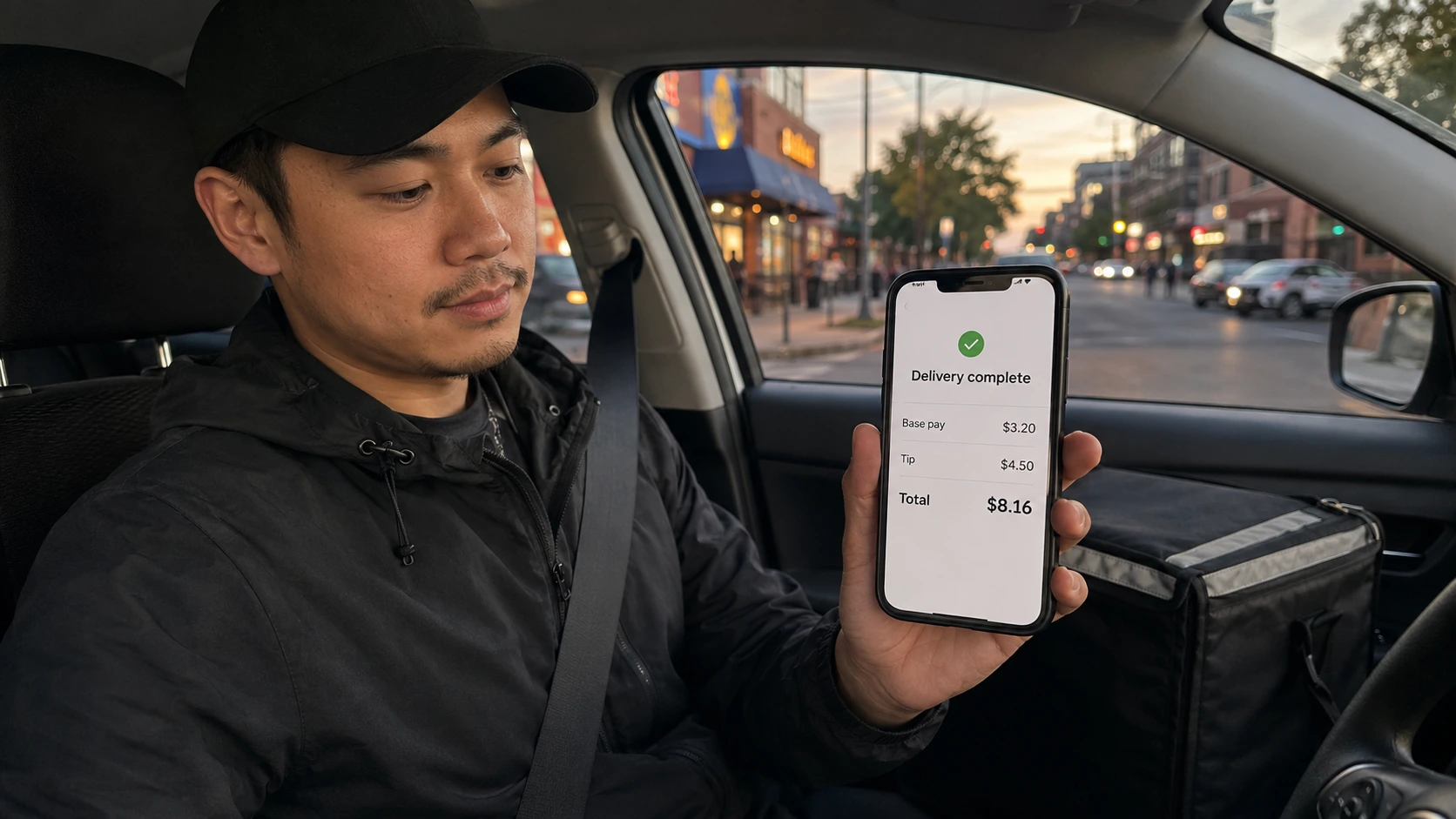
DoorDash advertises "$25+ per hour while actively on a delivery", but Gridwise data from 115,771 Dashers in 2025 puts the median at $11.26.
Both numbers are real; they just count different things. The $25 covers only the minutes you're on the road doing deliveries. The $11.26 covers the whole shift, including the dead miles and the waiting the app doesn't pay you for.
So how much do DoorDash drivers actually make once you total everything up? Closer to the second number than the first, and exactly where you land depends on your market, your mileage, and how selective you are about which orders you accept.
The waiting between orders doesn't have to be wasted time. Some drivers pair DoorDash with a no-overhead app like EarnStar, earning from games during the gaps to top up what they make.
How DoorDash pay actually works: Earn per Offer vs. Earn by Time
DoorDash pay comes from three parts: base pay, promotions, and tips. Drivers keep 100% of tips, and the app shows the guaranteed total before you accept an offer.
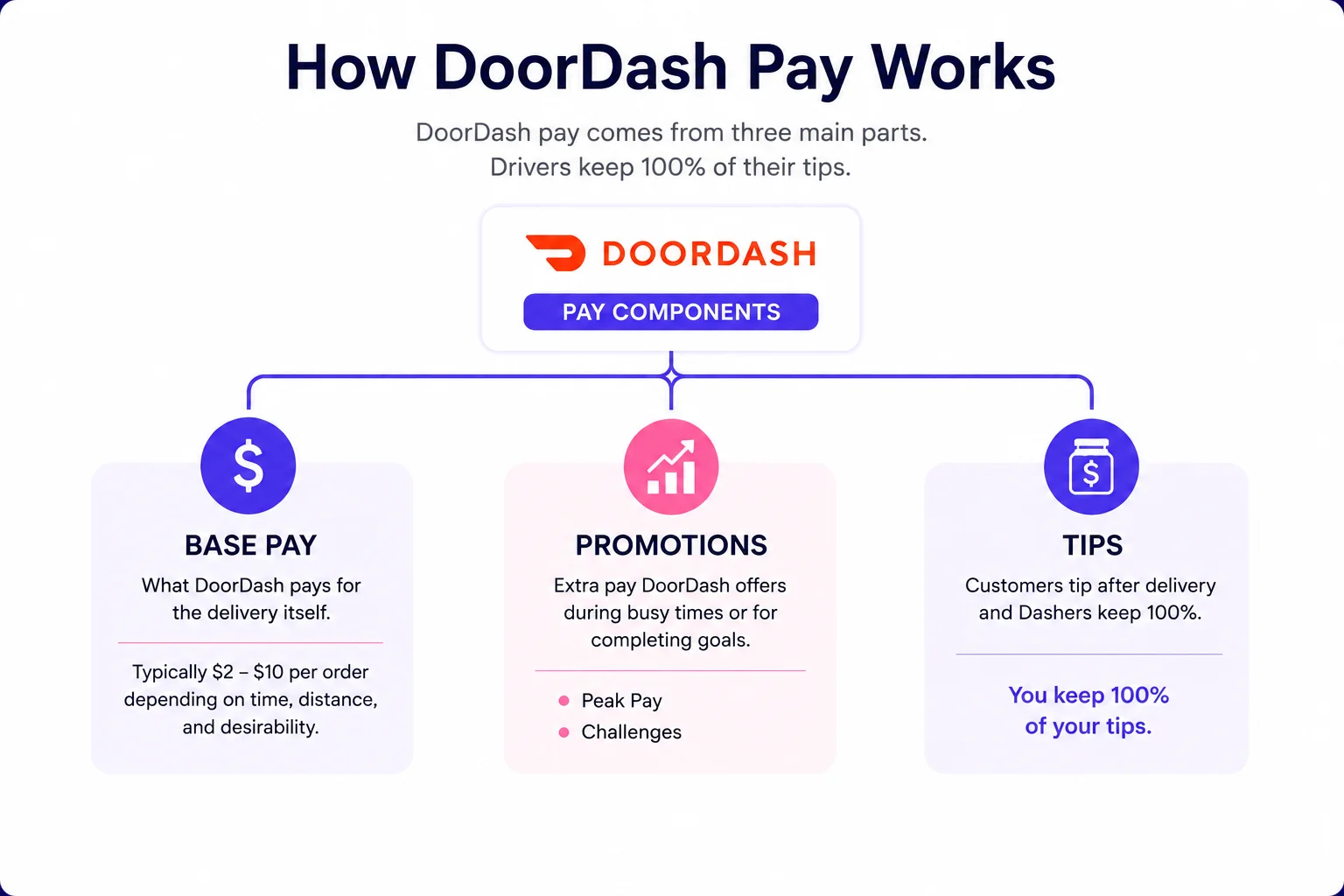
Base pay is what DoorDash contributes for the trip itself. Promotions include Peak Pay and Challenges, which add money during busy windows or for hitting delivery targets.
Peak Pay deserves a quick note, because it's where a lot of the real upside lives. It's an extra amount added on top of base pay during high-demand periods like dinner rushes and bad weather, and DoorDash sets the amount locally, so it shifts by market and by hour rather than following one national figure.
Where earnings really swing is the pay mode you're working in. DoorDash offers two, and most third-party guides skip this entirely, even though it changes how every shift adds up.
Earn per Offer mode
In Earn per Offer mode, you're paid per delivery: base pay plus any promotions plus 100% of the tip, with the dollar amount shown upfront before you accept. You can see the offer and decide whether it's worth your time.
Base pay typically ranges from $2 to $10 depending on the time, distance, and how desirable the order is, according to DoorDash. That $2 floor matters for your real hourly rate, because a $2 base order that eats 20 minutes and several miles is poor economics unless the tip carries it.
Earn by Time mode
In Earn by Time mode, you're paid a guaranteed hourly minimum for your active time plus 100% of tips, counted from the moment you accept an order to drop-off. It trades upside for predictability.
The catch is what "active time" means: it only counts the minutes from acceptance to delivery, not the gaps between orders. Newer drivers in slow markets often prefer the guarantee, while drivers in busy, tip-heavy markets often earn more per Offer.
How much do DoorDash drivers make per hour, really?
The real answer sits well below the headline. Three credible numbers describe Dasher pay, and they disagree because they measure different slices of the workday.
DoorDash's own "$25+ per hour" figure applies only while you're actively on a delivery. Everlance, which tracks gig mileage and earnings, reports an average of $20 to $25 per hour.
Gridwise's 2025 dataset of 115,771 drivers lands at a $11.26 per hour median in total trip pay. That is the broadest independent benchmark of the three, and the lowest, because it counts the whole shift.
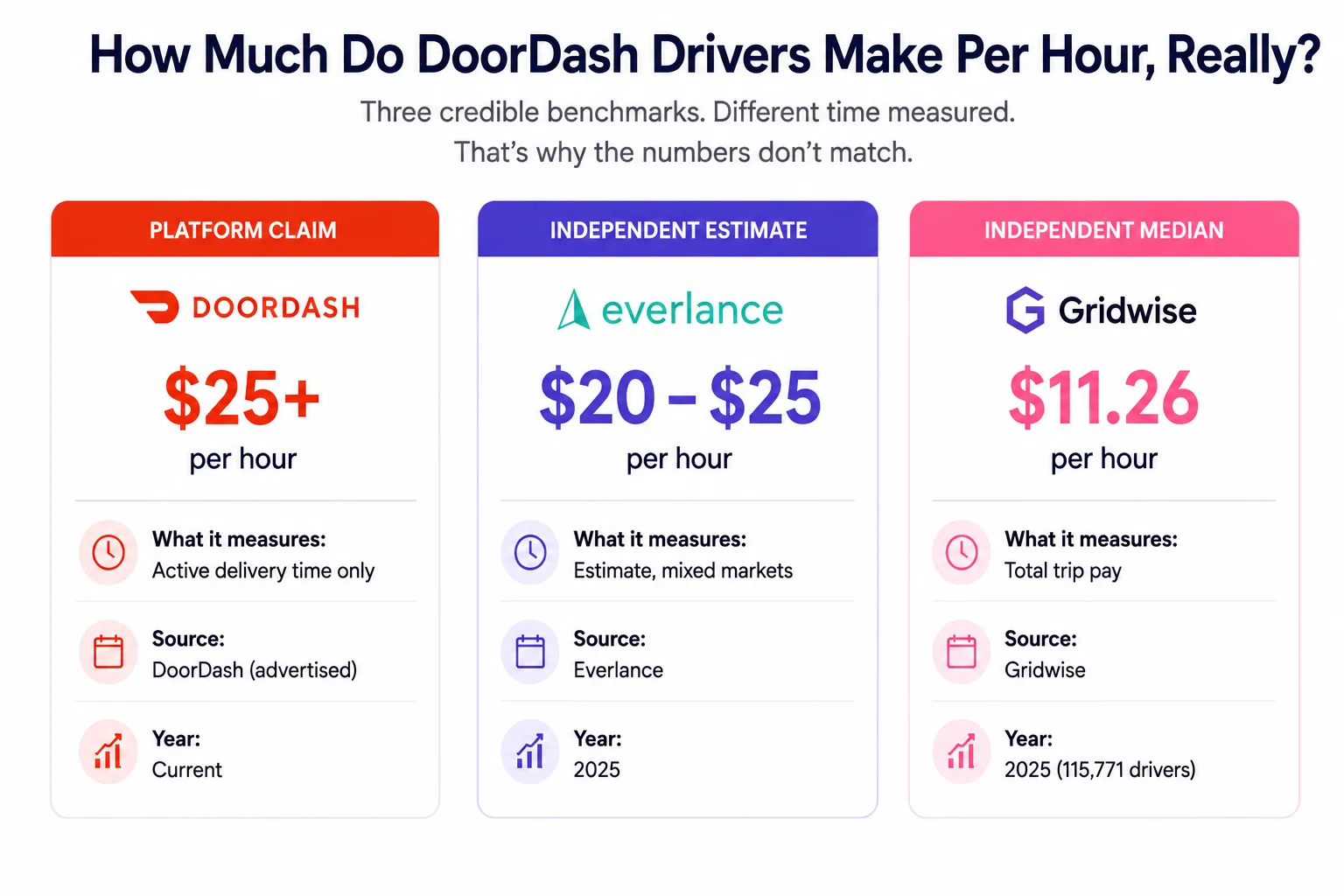
DoorDash's claim is technically accurate. The phrase "while actively on a delivery" is the key qualifier, because it excludes dead miles, waiting for orders, and time between trips.
That unpaid gap is exactly why your true rate looks different from the advertised one. Consider adding another manageable side hustle on top of DoorDash to potentially boost your hourly earnings.
A worked example: from $25/hr gross to real take-home
Take one hour where you're actively delivering and earning the advertised $25. Here's what's left after each real cost comes out:
- Gross pay: $25. One active hour at DoorDash's advertised rate.
- Subtract the cost of driving (about $13.05). Use the IRS standard mileage rate as an all-in proxy. At $0.725 per mile (the 2026 business rate), it already bundles gas, depreciation, and maintenance, so you don't subtract fuel on top, or you'd double-count. Cover a realistic 18 miles in that hour, once you count the drive to the restaurant, the drive to the customer, and repositioning, and that's roughly $13.05. Pre-tax net: $11.95.
- Subtract self-employment tax (about $1.83). As a 1099 contractor, you owe 15.3% on net profit, and 15.3% of $11.95 is about $1.83. Net: $10.12. (Simplified here; the 15.3% applies to most of your net profit, with part of it deductible.)
- Subtract unpaid dead time. You're not delivering every minute, so that active hour's pay stretches across more clock time, pulling your true rate lower still, much closer to the Gridwise median than to the $25 you started with.
The result: about $10 per active hour after driving costs and tax, and less again once dead time is in the picture.
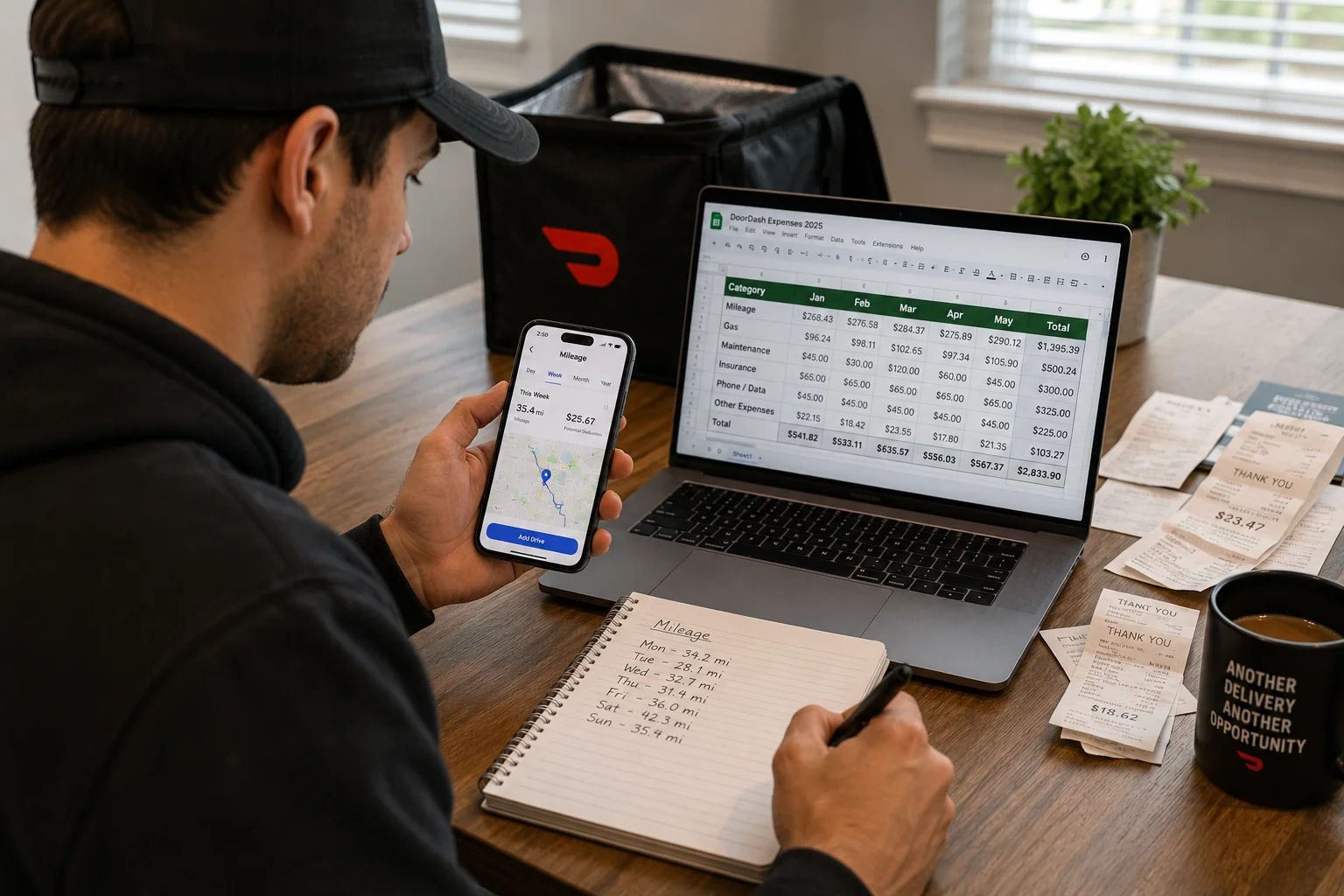
Run your own number: gross active pay minus (your miles times $0.725) gives pre-tax net, then subtract 15.3% of that net.
How much DoorDash pays by city
Where you drive changes your pay more than almost anything else. Dense, high-cost markets often pay the most per active-delivery hour, while quieter suburban markets pay less.
The figures below are estimated active-delivery ranges, not net take-home. A single city number is always a range rather than a guarantee.
| City / region | Estimated hourly range (active delivery) | Local notes |
|---|---|---|
| San Francisco Bay Area | ~$38/hr (2023) | Prop 22 floor, very high cost of living; regional outlier |
| Sacramento, CA | Elevated vs. national (2023) | Prop 22 coverage; California premium |
| New York City | High end of range | Dense orders, high tips, heavy traffic |
| Los Angeles | Mid-to-high | Sprawl adds dead miles between orders |
| Chicago | Mid range | Strong downtown density |
| Dallas | Mid range | Car-dependent, longer distances |
| Miami | Mid range | Seasonal tourist demand swings |
| Smaller / suburban markets | Lower end | Fewer orders, more waiting |
Most non-California markets cluster around the national picture, where the independent ranges from Gridwise and Everlance ($11.26/hr median up to roughly $25/hr active) are the better guide than any single city claim. Those labels are rough rankings, not precise hourly figures.
The California figures need a clear caveat. Bay Area drivers earned around $38 per hour while on deliveries in 2023, a 36% jump from 2020, according to DoorDash's own Prop 22 data, and Sacramento saw a similar premium in that same 2023 reporting.
Treat those as upper-bound regional benchmarks, not the national norm. They reflect 2023 data, active-delivery time only, and California's Prop 22 earnings floor, none of which describe what a typical driver pockets nationwide.
How much do DoorDash drivers make part-time vs. full-time?
The single-hour example above is one active hour carrying a heavy mileage load. Across a full shift, your clock hours include waiting and repositioning, so the per-hour expense bite is smaller, and the right number to plan around is blended pay across total time, not the active rate.
Using a realistic blended range of roughly $11 to $18 per hour, the projections below show gross alongside the net that actually matters.
Gridwise puts net pay at roughly $9 to $11 per hour at the median after gas, maintenance, and depreciation, so net here runs at about three-quarters of gross once self-employment tax is included.
| Hours/week | Est. weekly gross | Est. weekly net | Est. monthly net |
|---|---|---|---|
| 10 hrs | $110 to $180 | $80 to $135 | $320 to $540 |
| 20 hrs | $220 to $360 | $160 to $270 | $640 to $1,080 |
| 40 hrs | $440 to $720 | $320 to $540 | $1,280 to $2,160 |
Net is the number to plan around, not gross. After gas, mileage wear, and the 15.3% self-employment tax, your real take-home pay is well below the top-line figure.
There's also a practical point about hours. Forty hours of dashing isn't 40 hours of paid delivery, because waiting and driving between orders eat into the clock without paying you.
Some drivers use those gaps to chip away at other small earners, like platforms offering free Amazon gift cards for completing tasks and playing games, so the downtime isn't a total write-off.
Why a single app has an earnings ceiling
A single delivery app has a practical weekly cap, and it's worth understanding why before you plan around full-time hours. Pay is tied to active-delivery time, so the only levers you control are hours worked, how selectively you accept orders, and whether your market has enough demand to keep you busy.
Demand is the real ceiling. Even a full 40-hour week only pays for the minutes orders are actually flowing, and most markets have a finite number of profitable dinner-rush and weekend windows.
Once you've claimed the busy hours, adding more time often means more dead miles for less pay per hour, not a proportional jump in earnings. This is where diminishing returns set in, and extra hours on the same app stop paying off.
This is exactly why many drivers stack income sources rather than chase more hours on one platform. They run DoorDash during peak windows, then fill the slow gaps with something that doesn't burn gas or add vehicle wear.
DoorDash taxes and expenses drivers can't ignore
Dashers are independent contractors, which means taxes work differently than a regular paycheck. You owe a 15.3% self-employment tax on net earnings, and DoorDash withholds nothing, so the money has to come out of what you earn.
Because nothing is withheld, the IRS generally expects self-employed earners to pay estimated taxes four times a year rather than once at filing. A common approach is to set aside a portion of every payout, often somewhere around 25% to 30% depending on your total income, so the quarterly bill doesn't catch you short.
Those quarterly payments typically fall in mid-April, mid-June, mid-September, and mid-January of the following year. Missing them can trigger underpayment penalties, so most drivers earning real money treat the set-aside as non-negotiable.
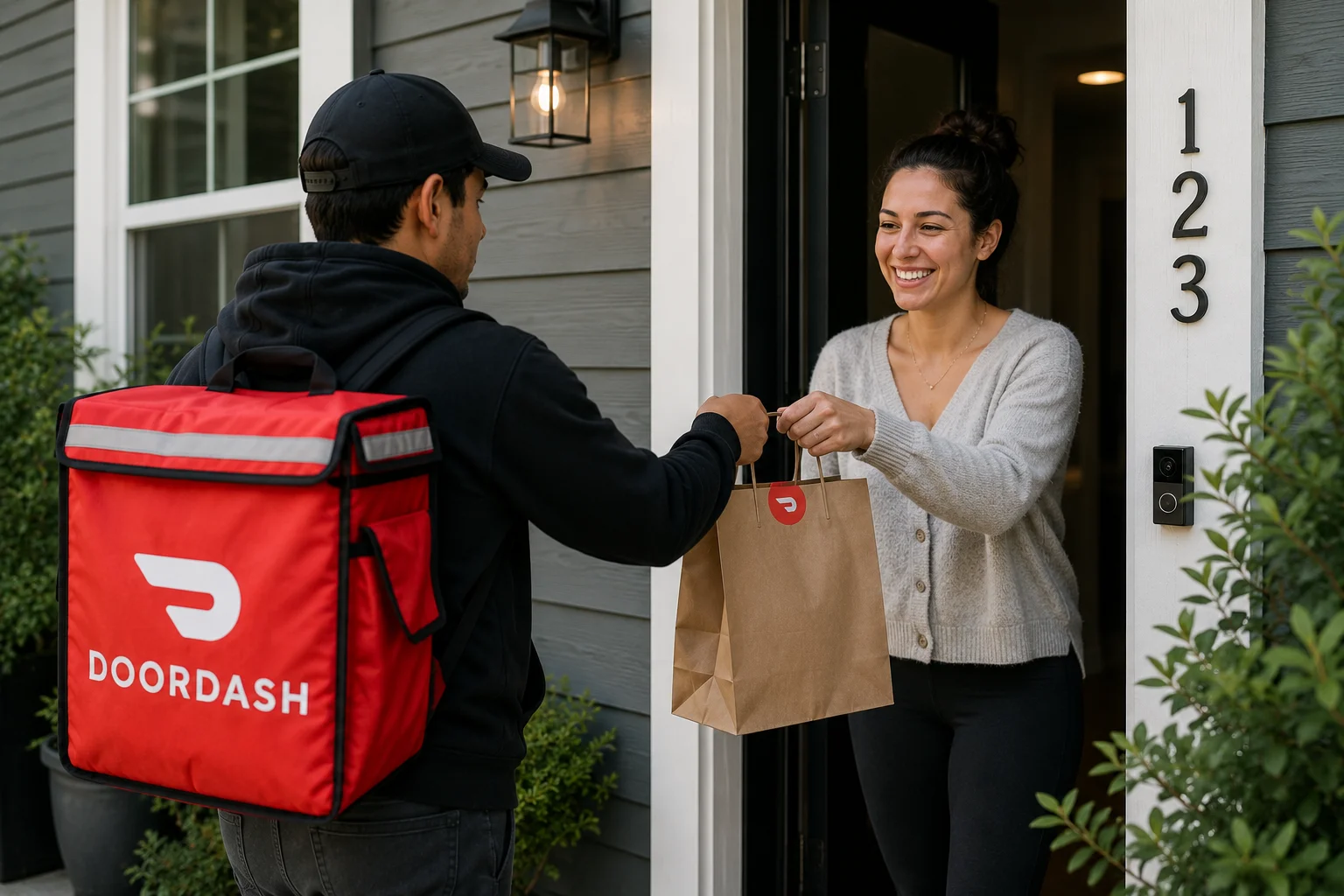
The good news is that deductions lower your taxable income, and the mileage write-off is usually the biggest one for delivery drivers. You choose one of two methods, and you can't mix them on the same vehicle in the same year.
- Standard mileage method: multiply your business miles by the 2026 IRS rate of $0.725 per mile. Simple to track and usually the larger deduction for high-mileage drivers.
- Actual expense method: add up the real costs (gas, insurance, repairs, depreciation, lease payments) and deduct the business-use share. More paperwork, but it can win if your vehicle is expensive to run.
Expenses also include the costs gross-pay guides quietly skip:
- Gas for every mile, including the unpaid dead miles between orders
- Vehicle depreciation and wear, which climbs fast at high mileage
- Maintenance like tires, brakes, and oil changes
- Insurance considerations, since personal auto policies may not fully cover delivery work
- The portion of phone and data costs used for dashing
This is general information, not tax advice. Confirm your situation with a qualified tax professional before filing.
DoorDash vs. lower-overhead ways to earn
DoorDash is a legitimate way to earn, but it carries real overhead that the headline pay hides. You need a car, gas, insurance, active driving time, and you take on the tax complexity of 1099 income.
That overhead is the trade-off. Every mile adds wear, every gap between orders is unpaid, and every dollar of net pay comes after expenses you have to track yourself.
Lower-barrier options earn from time you'd otherwise spend idle, without a vehicle or mileage in the equation. EarnStar lets you earn by playing games you already play, with no car, no gas, and none of the 1099-driving setup.
| Option | Startup cost | Vehicle/gas needed | Tax complexity | Flexibility |
|---|---|---|---|---|
| DoorDash | Car, insurance, fuel | Yes | High (1099, SE tax, quarterly) | High, but tied to driving |
| EarnStar | Free app download | No | Low | High, earn anytime |
| HeyCash | Free app download | No | Low | High, casual play |
| PaidTester | Free signup | No | Low | High, task-based |
| Prime Opinion | Free signup | No | Low | High, survey-based |
| TopSurveys | Free signup | No | Low | High, survey-based |
| FiveSurveys | Free signup | No | Low | High, survey-based |
These aren't a replacement for driving if you want active road hours. They work as a second layer: DoorDash for the hours you're out delivering, a rewards app for the downtime in between.
Where EarnStar fits in your income stack
Dead miles and waiting between orders are hours you're not earning, and they still cost you gas and wear. A rewards app turns some of that idle time into earnings with no vehicle overhead and no mileage depreciation. EarnStar works across iOS, Android, and the web, so you can earn between orders or on the couch.
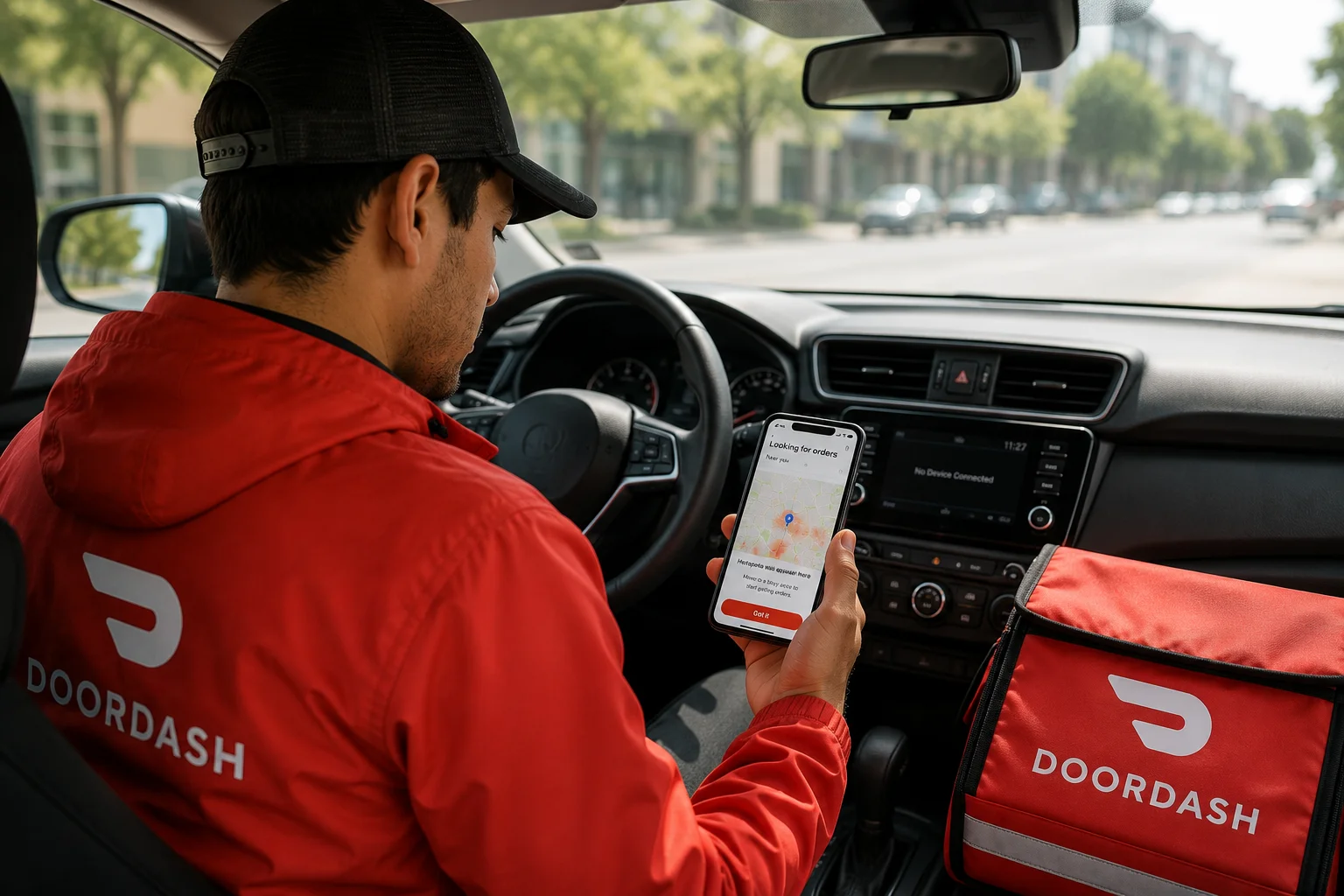
Payouts are fast, and you can cash out with a low minimum threshold rather than waiting to clear a high bar, which is the difference between earning during a slow dinner shift and earning nothing at all.
If games aren't your thing, the same idle-time logic applies to surveys and app testing. Prime Opinion, TopSurveys, and FiveSurveys focus on surveys, PaidTester pays for testing apps and websites, and HeyCash is built for casual gaming with earnings as a bonus.
Is DoorDash worth it in 2026?
DoorDash can absolutely be worth it for flexible, active hours, especially if you're selective about which orders you accept. But the headline pay overstates take-home once gas, mileage, dead time, and the 15.3% self-employment tax come out.
So how much do DoorDash drivers make in real terms? The honest answer lands far closer to the Gridwise median near $11 per hour than the advertised $25+, with high-cost markets like the Bay Area as outliers rather than the norm.
It suits people who want flexible road hours and don't mind the vehicle and tax overhead. If you'd rather not put miles on your car for every dollar, it makes sense to diversify and earn from idle time too.
A no-overhead app like EarnStar pairs well here, helping you make up the shortfall during otherwise unpaid time. EarnStar is free on iOS, Android, and the web, so you can start earning today.
Frequently asked questions
Common questions about DoorDash earnings

Turn spare time into cash
Turn your downtime into real cash and gift cards, with simple tasks, clear milestones, and fast withdrawals when you're ready.