Updated 10 September 2026
How we got these numbers: figures come from ZipRecruiter and Glassdoor salary data, Esports Charts and Esports Insider, and Newzoo, with each figure linked to its source. Pay data pulled 10 September 2026.
How much do gamers make? For almost everyone, the honest answer is nothing from simply playing. Real gaming income is a niche, split across pros, streamers, testers, and casual reward-app users, and the numbers between those tiers are miles apart. Here's what each type of gamer actually earns in 2026.
The short answer:
- The average person earns $0 from playing games for fun. Paid gaming is the exception, not the rule.
- A "gamer" job averages $31,769 a year, about $15.27 an hour, on ZipRecruiter.
- Pro esports pays roughly $50,000 to $60,000 at entry and $200,000 to $480,000 at the top, with the global average estimated near $138,000.
- Small streamers make about $50 to $1,500 a month.
- Reward apps pay casual players around $5 to $50 a month.

How much do gamers make per hour, per day, per month and per year
Gaming income doesn't fit one number, so here it is across every period, by tier. Per-hour and per-day figures are effective averages from typical earnings, not guaranteed rates. Game testing is the only tier paid as an actual hourly or salaried job.
| Gamer tier | Per hour (effective) | Per day | Per month | Per year |
|---|---|---|---|---|
| Casual / reward apps | Pennies to ~$1 | $0.20 to $2 | $5 to $50 | $60 to $600 |
| Small streamers & creators | Varies | $2 to $50 | $50 to $1,500 | $600 to $18,000 |
| Game testers / QA | $15 to $30 | $120 to $240 | $2,500 to $5,300 | $30,000 to $63,000 |
| Semi-pro (T2) esports | Salary-based | $100 to $265 | $3,000 to $8,000 | $36,000 to $96,000 |
| Pro (T1) esports | Salary-based | $330 to $1,300+ | $10,000 to $40,000+ | $120,000 to $480,000+ |
| Elite / top pros | Salary-based | $1,600+ | $50,000 to $500,000+ | $600,000+ |
The pattern to take from this is the gap. The step from a reward app to a tester salary is a hundredfold, and the step from there to an elite pro is another hundredfold. Almost nobody sits at the top, which is why "how much do gamers make" has no single answer.
How much do professional gamers make
Professional esports is where the biggest salaries sit, and where most gaming-pay questions start. One widely cited industry estimate puts the global average pro gamer salary near $138,000, but that average is close to meaningless on its own, because it blends players earning $50,000 with players earning ten times that. The distribution is skewed hard toward the top.
The more useful way to read a professional gamer salary is by game, region, and career level.
Professional gamer salary by game
Not every title pays the same. Published salaries are scarce and vary widely by source, so treat these as reported ranges rather than official figures.
| Game | Entry-level salary | Top-tier salary |
|---|---|---|
| Counter-Strike 2 | ~$50,000 to $60,000 | Up to ~$480,000 |
| League of Legends | ~$50,000 to $75,000 | ~$200,000 to $400,000+ |
| VALORANT | ~$50,000 | Up to ~$420,000 |
Top League of Legends and VALORANT players draw $200,000 to $480,000 a year in salary on top of tournament winnings, per Esports Insider, and Counter-Strike 2 organisations make some of the largest roster investments of any title. Below the top tier, pay drops sharply, and players in smaller regions or lower divisions earn a fraction of these figures.
Professional gamer salary by region
Geography moves the number nearly as much as skill does. North America pays the highest salaries, with top organisations well into six figures. Korean and Chinese tier-one teams compete closely with North American pay, Europe trails but has been closing the gap, and the rest of the Asia-Pacific region and smaller markets sit below that. If you're weighing a pro path, where you compete matters, though relocation brings cost-of-living and visa trade-offs worth counting.
Professional gamer salary by career level
- Semi-pro (tier two): roughly $36,000 to $96,000 a year, usually a mix of a smaller team salary, prize money, and streaming.
- Pro (tier one): roughly $120,000 to $480,000 a year in salary, before prize pools, sponsorships, and content revenue.
- Elite: $600,000 a year and up once winnings, sponsorships, and equity stack on top of a base salary.

Esports prize money and the highest-paid gamers
Prize money is separate from salary, and it's far more concentrated. Across all of 2025, about $270 million was awarded in esports prize money worldwide, per Esports Charts, with Counter-Strike 2 leading at roughly $25 million. The single richest event was the $70.45 million Esports World Cup in Riyadh, the largest prize pool in esports history.
The all-time earners table is dominated by one game, because Dota 2's crowdfunded International tournaments once produced prize pools no other title has matched.
| Player | Game | Career prize money |
|---|---|---|
| N0tail (Johan Sundstein) | Dota 2 | ~$7.18 million |
| JerAx (Jesse Vainikka) | Dota 2 | ~$6.4 million |
| ana (Anathan Pham) | Dota 2 | ~$6.0 million |
| Collapse (Magomed Khalilov) | Dota 2 | ~$5.9 million |
| Miposhka (Yaroslav Naidenov) | Dota 2 | ~$5.5 million |
All five are veterans of OG and Team Spirit, per Esports Earnings, and the exact order shifts as recent tournaments pay out. One caveat matters, though. Prize money isn't the same as wealth. League of Legends legend Faker has won only about $1.8 million in prizes, which ranks him far down this list, yet his net worth is estimated at $30 to $50 million once salary, endorsements, and his stake in T1 are counted. Prize-money tables measure which games have big crowdfunded pools, not which players are rich.
How much do streamers make
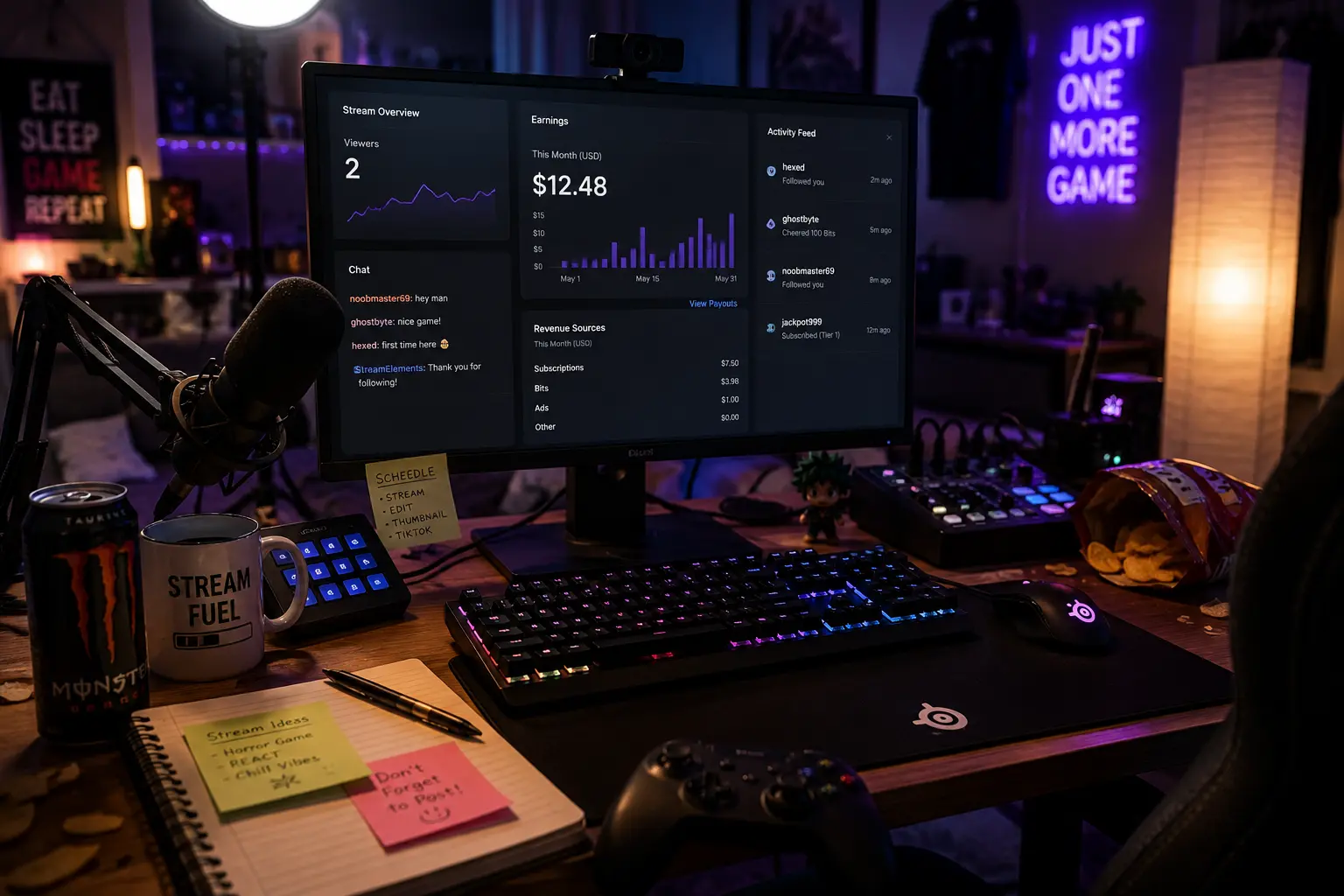
Streaming is the most accessible income path in gaming, and pay maps almost entirely to audience size. Small streamers with a handful to a hundred regular viewers earn roughly $50 to $1,500 a month from subs, bits, ads, and the occasional sponsorship. The middle is a long grind, and only a thin top tier reaches the six-figure-a-month headlines. The median streamer earns close to nothing, because a few huge channels pull the average up.
We break the tiers down in full, with what streamers actually keep after Twitch's cut and taxes, in our guide to how much Twitch streamers make.
How much do YouTube gamers make
YouTube gaming pays differently from streaming, and the range is enormous, from creators earning nothing to a few pulling in millions. Most earn very little. The money arrives through three streams:
- Ad revenue: gaming CPM (what advertisers pay per 1,000 views) runs about $1 to $5, so 100,000 views earns roughly $100 to $500.
- Sponsorships: mid-to-large creators command $5,000 to $50,000 or more per sponsored video, the biggest single payday.
- Everything else: memberships, merchandise, and affiliate links add recurring income on top.
The advantage over Twitch is shelf life. A well-optimised video keeps earning ad revenue for months or years, while a stream is mostly watched live. For anyone who can't stream 30-plus hours a week, YouTube's on-demand model is often the more practical path, and niche content like guides, patch breakdowns, and tier lists tends to draw higher-CPM ads than generic gameplay.
How much do game testers make
If you want a stable gaming job without the winner-take-all odds of esports or streaming, game testing is the realistic entry point. The US salary ladder runs like this:
- Entry level: $30,000 to $50,000 to start, with no specific degree required.
- Established testers: $58,000 to $63,000 a year on average, per Glassdoor.
- Senior QA and QA leads: $70,000 to $90,000+, with a path into design or production from there.
The work rewards attention to detail and patience over reflexes or charisma. Many testers start on contracts at firms like Keywords Studios before moving in-house, and from there the path can lead into game design, production, or specialised roles like localisation QA, all of which pay more.

Do gamers make money without going pro
For most people reading this, this tier is the realistic one. Half of all mobile gamers have already earned cash, rewards, or gift cards from playing on their phones, per a 2,000-player survey from rewards firm Almedia. You don't need an audience or a ranking.
What reward apps realistically pay
Reward apps let anyone earn regardless of skill. You play games, complete tasks, or take surveys, and you earn real cash or gift cards. The realistic figure is $5 to $50 a month for casual users. That's not quitting-your-job money, and anyone who tells you otherwise is overselling it, but it's low-effort cash for time you'd spend gaming anyway.
EarnStar, which we own, is a hybrid app that combines game rewards with paid surveys. You download it free, choose games or surveys or both, and cash out from $5 via PayPal, gift cards, and other methods.
Reward apps vs crypto play-to-earn
One distinction is worth knowing. Reward apps pay you directly for your time. Crypto and NFT play-to-earn games ask you to buy in and speculate on token values, which carries real financial risk. They're different categories, so check which one a platform is before you spend any time on it.

Can you make a living playing video games?
Only a few thousand players worldwide earn a full-time living from competitive esports alone. The esports audience runs into the hundreds of millions, but the vast majority of those viewers will never earn a dollar from playing. That doesn't make gaming income a fantasy. It means the definition of "a living from gaming" has widened well beyond going pro.
A realistic gaming income today often looks like a portfolio. A Twitch stream bringing in $500 a month, a YouTube channel adding $300, occasional freelance game testing at $20 an hour, and a reward app kicking in $30. None of those pays rent alone. Combined, they're a meaningful side income, and for some a foundation to build on.
Here's a rough guide by time invested:
- Casual (1 to 5 hours a week): $5 to $50 a month from reward apps. Low effort, low return, but real money for time you'd spend gaming anyway.
- Committed (10 to 20 hours a week): $100 to $1,500 a month from streaming or YouTube while an audience builds, with sponsorships lifting that once you break through. The price of entry is consistency over months.
- Full-time (40+ hours a week): career-level income from pro esports, established content, game testing, or development. It takes serious skill, time, or both.
For most people, the smart first move is a no-risk option, then adding streams as skill and time allow.
What decides how much a gamer earns
Four things move a gamer's income more than raw skill does. The game matters, because a title with big prize pools, a funded league, or high ad rates pays more than one without. Region matters, since the same skill earns more in North America or Korea than in a smaller market.
Audience size sets streaming and YouTube income almost on its own, as pay tracks viewers and subscribers far more than mechanics. And revenue mix decides stability, because the earners who last rarely rely on one source; they stack salary, prizes, sponsorships, content, and rewards so a bad month in one doesn't sink the rest.
FAQs about gamer earnings

Get Paid to Play
EarnStar pays you real cash for playing games on your phone. Cash out to PayPal or 200+ other methods anytime.