Instacart shoppers make an average of $18.33 per hour according to ZipRecruiter's July 2026 data, but tracked earnings from 20,538 real shoppers put the median at $12.21 per hour in trip pay, per Gridwise's 2025 dataset.
The gap comes from what each number measures. Aggregator averages pool self-reported gross pay, while the tracked median reflects logged batches and shrinks to about $10 to $12 per hour once gas and vehicle costs come out.
Tips carry about 42% of a shopper's total pay, the highest tip share Gridwise tracks on any gig platform. Where you land between those two numbers comes down to your market, your batch choices, and how much of the gross your car eats. Every figure in this guide is an estimate; treat the ranges as a planning tool rather than a promise.
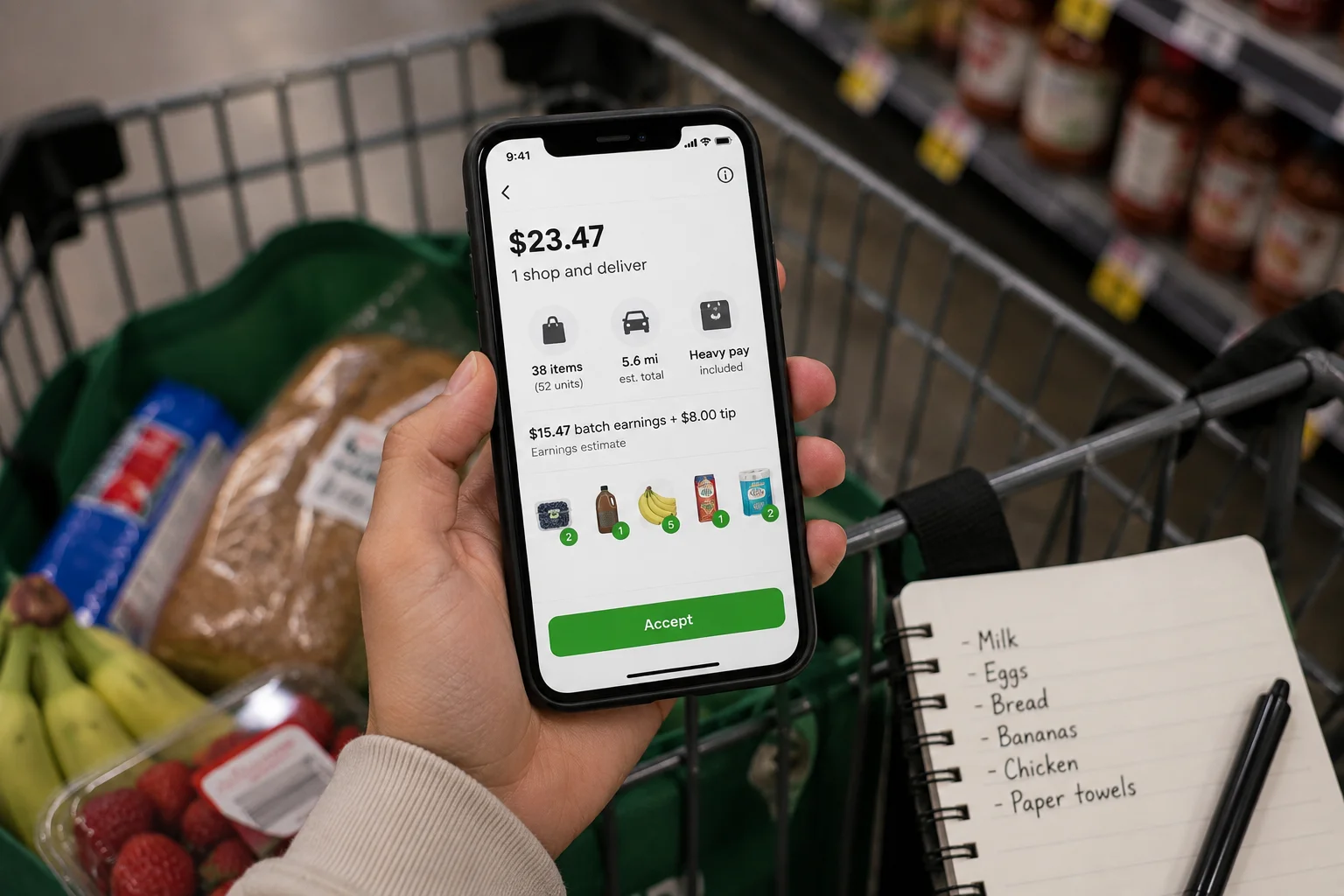
So how much do Instacart shoppers really make?
Most full-service Instacart shoppers earn between $11 and $18 per hour before expenses. The spread is wide because the two main sources measure different things.
ZipRecruiter averages self-reported pay and lands at $18.33 per hour nationwide, inside a range of $11.06 to $43.27, with an average annual figure of $38,119. Self-reported numbers skew high because shoppers remember gross pay on good days.
Gridwise tracked 20,538 shoppers through 2025 and logged a median of $12.21 per hour in total trip pay, which lands at $10 to $12 after expenses. The tracked panel is the better guide to a typical week.
Four numbers frame the whole debate.
- Aggregator average: $18.33 per hour (ZipRecruiter, July 2026)
- Tracked median: $12.21 per hour in trip pay (Gridwise, 20,538 shoppers)
- Top 25% of tracked shoppers: $14.98 per hour or more
- Top 10% of tracked shoppers: $18.44 per hour
If you want one planning number, use the tracked median. Reaching the aggregator average puts you near the top tenth of shoppers, not the middle.
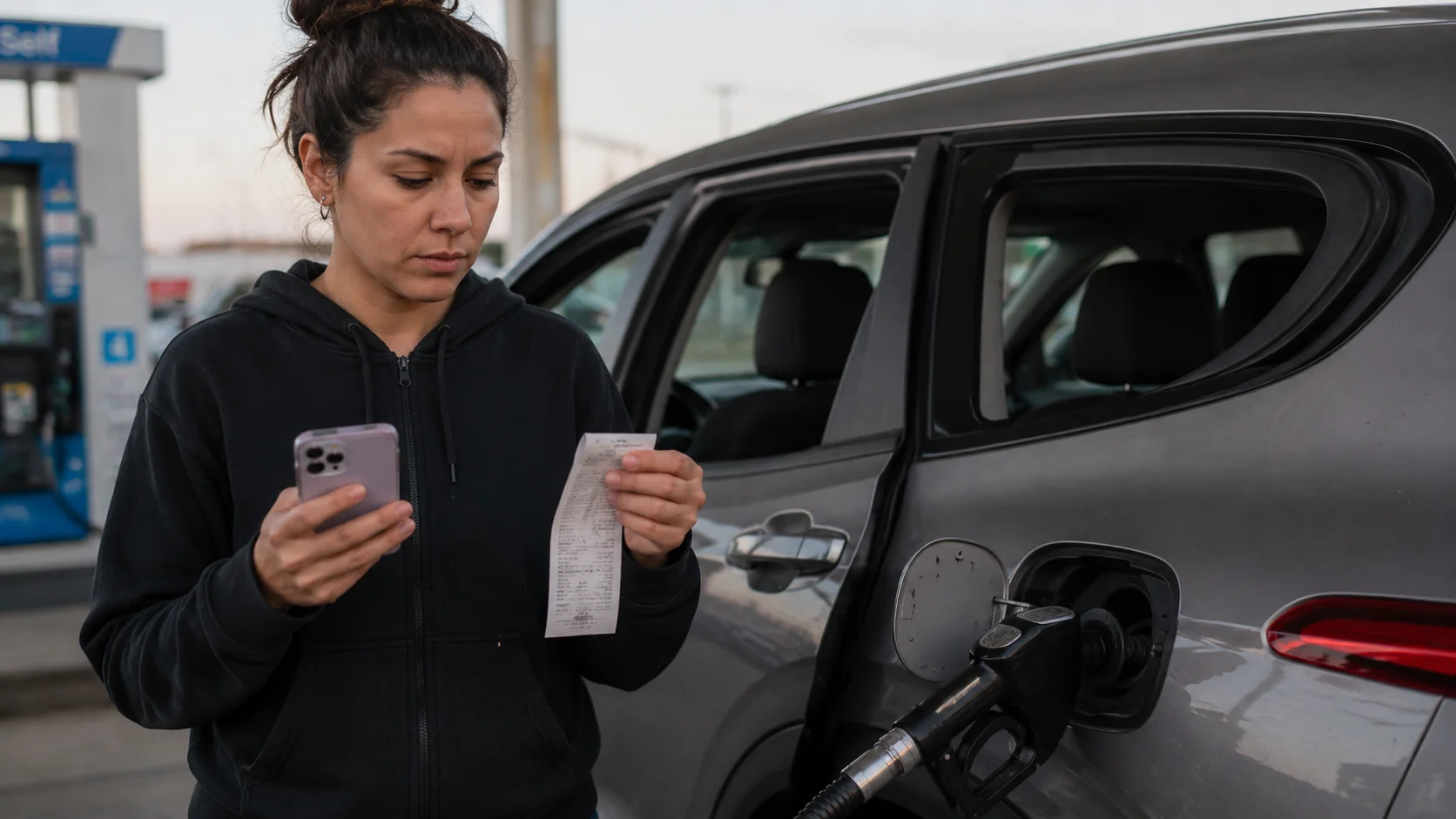
How much do Instacart shoppers make per hour?
Tracked shoppers log a median of $12.21 per hour in trip pay, and the average sits at $12.93. Only the top 10% clear $18.44 per hour, which is roughly the aggregator average.
What a real hour looks like
NerdWallet writer Tommy Tindall tested the job himself and earned $80.29 over just under seven hours online in the app, an effective $11.47 per hour. Tips did much of the work, since $32 of the $80.29 came from customers.
By his own estimate he worked closer to 10 hours once the time spent parked and waiting for batch offers counted, which drops the rate to about $8 per hour. One shopper's test is a small sample, but it lands right where the tracked median sits.
Online hours vs total hours
Pay accrues only while you're on a batch, so the same shift produces two different hourly rates. Tindall's $11.47 rate covered his hours online in the app; spread across the 10 hours he actually worked, it fell to about $8, and that drag grows in slow markets with few batch offers.
The batches themselves are slow money too. The median shopper completes 0.96 batches per hour, roughly one every 62 minutes, because each batch includes the in-store shop, checkout, loading, and the drive to the customer.
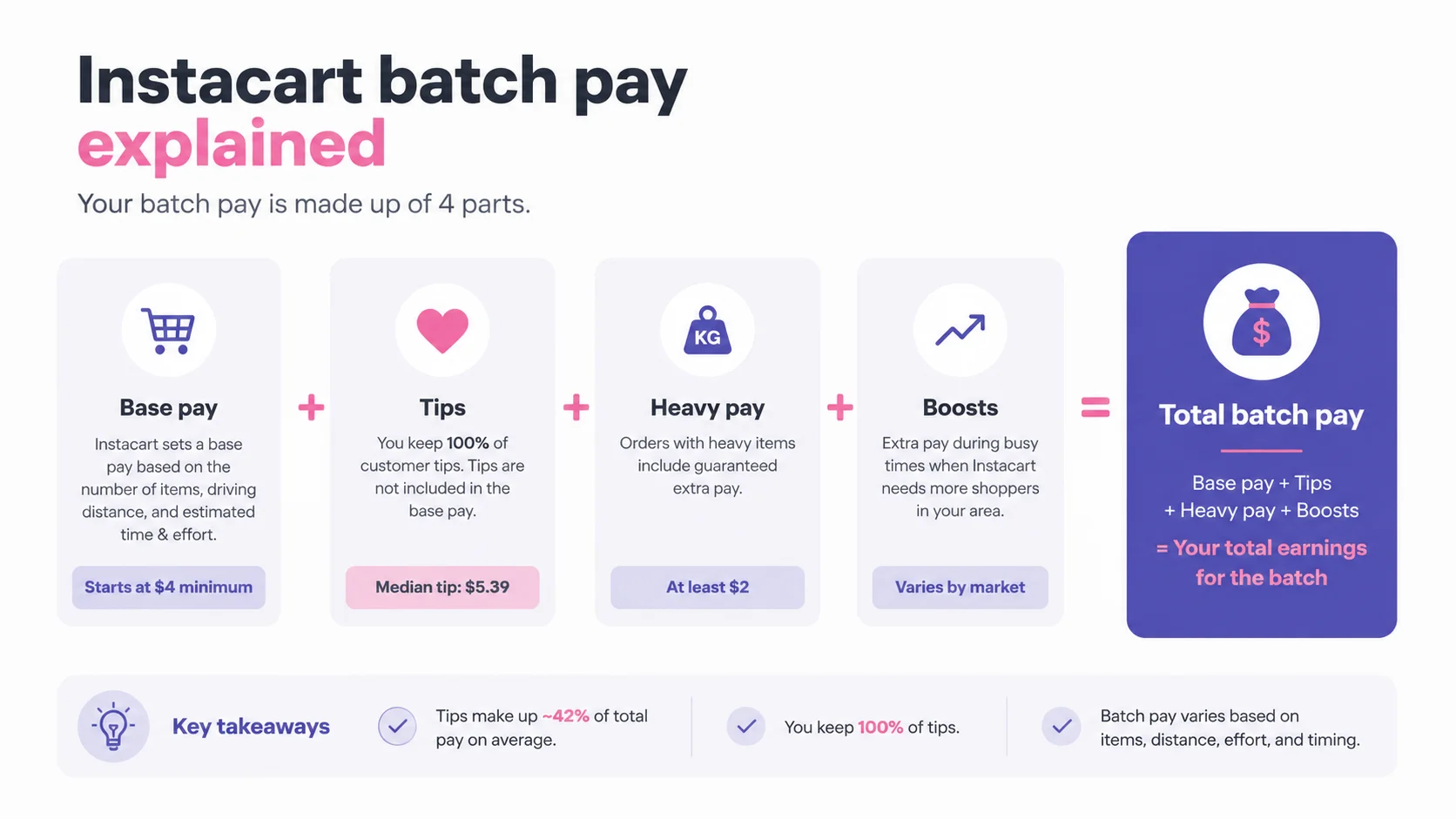
How Instacart batch pay works
A batch pays base pay plus 100% of the customer's tip, with heavy pay and boosts added on qualifying orders. Instacart sets the base using the number of items, the driving distance, and the expected shopping time and effort.
Batch pay minimum and heavy pay
Base pay starts at a $4 minimum for the smallest, quickest orders. The floor used to be higher: Supermarket News covered the cut from $7 to $4, a change shoppers still cite, alongside Instacart's claim that its guaranteed batch earnings run twice the competition's. Treat the $4 as the floor for tiny batches, not the expected payout on a normal order, and remember tips sit on top of that floor, never inside it.
Heavy orders carry guaranteed extra pay. Batches with several heavy items add heavy pay of at least $2 on top of the base, flagged with a heavy pay tag on the batch screen, per Instacart's shopper earnings page.
How much you make per order or batch
Individual offers land far apart, as Gridwise's batch data and NerdWallet's real-world test both show.
| Batch example | Offer or figure |
|---|---|
| Four items, one store (NerdWallet test) | $6.22 |
| Two-store batch (NerdWallet test) | $21.63 |
| Median batch, all-in (Gridwise) | $12.79 |
| Average batch, all-in (Gridwise) | $13.63 |
| Top 10% of batches (Gridwise) | $18.96 or more |
Base pay before tips vs after tips
Tips make or break a batch. The median tip is $5.39, and tips account for about 42% of total shopper pay, more than on any other platform Gridwise measures.
You keep 100% of every customer tip, split evenly when a batch takes two shoppers. If a customer zeroes out a tip after delivery without reporting an order issue, Instacart's tip protection covers up to $10 of it, which blunts the tip-baiting worry shoppers raise in forums.
Why your hourly pay is higher or lower
Batch selection moves your hourly rate more than anything else, followed by your market, the hours you work, and the expenses your car absorbs. Two shoppers on the same day in the same city can finish $5 an hour apart.
Expenses turn gross into net
A typical shopper nets $10 to $12 per hour after gas, mileage, and vehicle wear, down from a $12 to $13 gross, per Gridwise. The median shopper earns $2.84 per mile driven, so a long-drive batch eats more of its payout than a short one.
Boosts, peak times, and quality bonuses
Instacart adds Boosts to some batches when there aren't enough shoppers nearby to meet demand, and the app's peak earning times page shows which days and hours pay more per batch up to a week ahead, though it isn't available in every area. Instacart has also paid Quality Bonuses as additional payments on applicable batches.
Working a boosted window at a busy store is the simplest way to push a $12 hour toward $15 or more, because the extra pay lands on batches you would have run anyway.
Can you make $1,000 a week with Instacart?
A small share of full-service shoppers reach $1,000 a week, but it takes 40-plus hours at a rate above even the top 10% pace, in a strong market with sharp batch selection. The Budget Diet's 2026 figures put most shoppers at $300 to $500 per week, with $1,000-plus weeks limited to busy markets, steady batches, and high ratings.
The tracked medians show what those hours pay for most people.
| Hours per week | At the median ($12.21/hr) | At a top 10% pace ($18.44/hr) |
|---|---|---|
| 10 | ~$122 | ~$184 |
| 20 | ~$244 | ~$369 |
| 30 | ~$366 | ~$553 |
| 40 | ~$488 | ~$738 |
Even beating the top 10% pace across a full 40-hour week leaves you short of four figures, which is why the $1,000 stories come from dense, high-tip metros where the effective rate runs well past $18.44. In-store shoppers can't get there at all, since the 29-hour weekly cap tops out near $560 a week at Indeed's $19.25 average.
How much Instacart shoppers make by location
Your market can shift Instacart pay by several dollars an hour. ZipRecruiter's national spread runs from $23,000 to $90,000 a year, with the majority of shoppers landing between $26,000 (25th percentile) and $45,500 (75th percentile), roughly $12.50 to $21.90 per hour, and top earners reaching $52,500.
Dense metros tend to pay more because batches stack closer together and tips run higher. The trade-off is competition, since popular zones have more shoppers grabbing the best batches, and a newcomer sees fewer good offers in week one than the posted rate suggests.
In-store vs full-service shopper pay
In-store shoppers are W-2 employees earning roughly $17 to $19 per hour, while full-service shoppers are 1099 contractors whose pay depends entirely on the batches they run. Indeed puts the in-store average at $19.25, while Glassdoor's estimate runs lower, with a median of $17 inside a $15 to $20 range.
The two roles differ in more than the pay figure.
| In-store shopper | Full-service shopper | |
|---|---|---|
| What you do | Shop orders inside one store | Shop and deliver |
| Pay type | Hourly wage | Per batch (base plus tips) |
| Tax status | W-2 part-time employee | 1099 independent contractor |
| Hours | Capped at 29 per week | Self-scheduled, uncapped |
| Car needed | No | Yes |
The in-store wage doesn't swing with tips or gas prices, but the 29-hour cap tops out annual pay near $29,000 at the Indeed average, with no way to scale it.
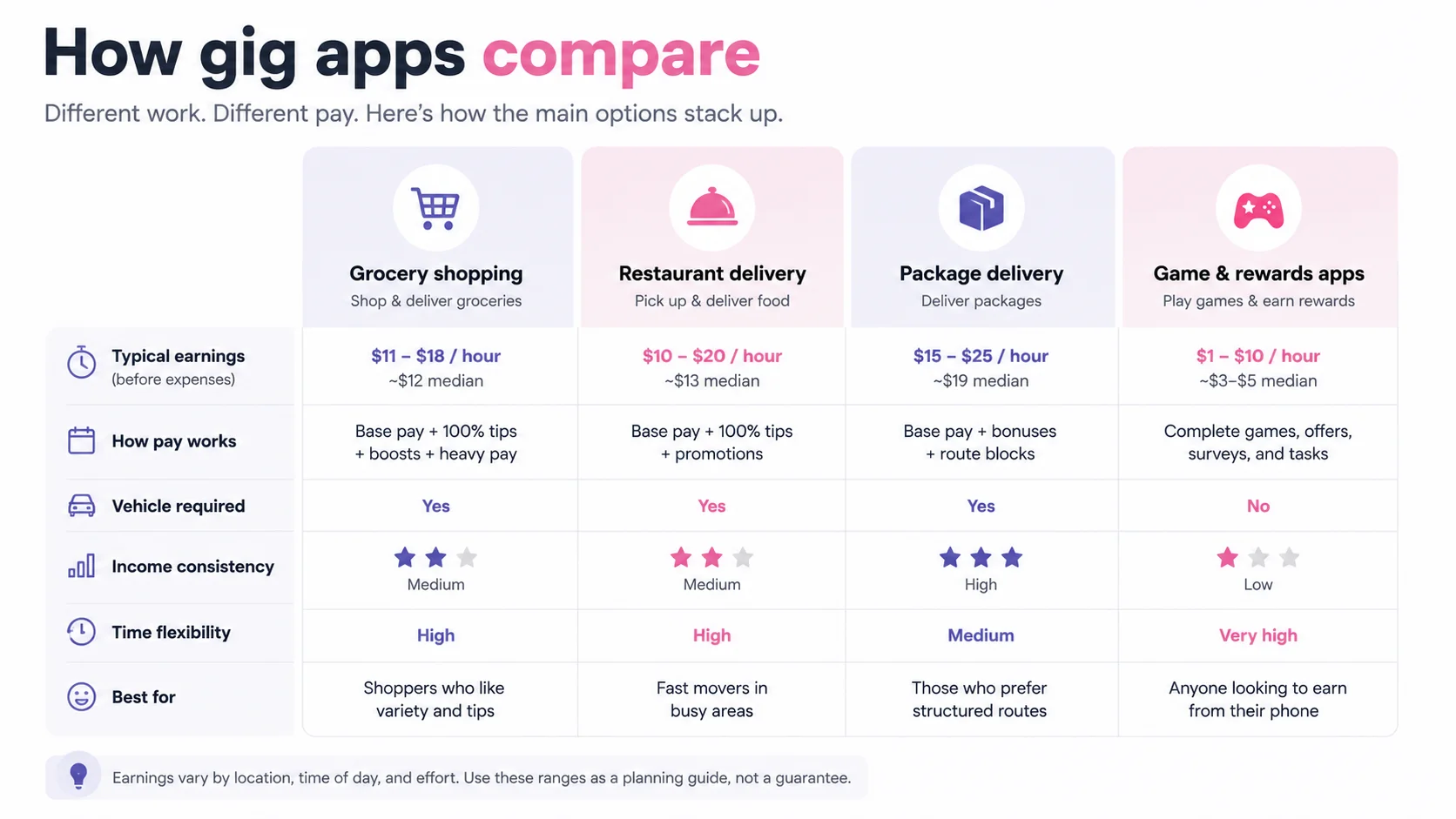
Instacart vs DoorDash, Uber Eats, and Amazon Flex
Instacart pays more per job than DoorDash or Uber Eats but hands you fewer jobs per hour, which is how a $12.79 median batch still produces a $12 hour.
Pay per job and pace
The median Instacart batch pays about 72% more than the median DoorDash delivery, per Gridwise's cross-platform data. Each grocery batch means shopping a full order, so a job takes longer from acceptance to drop-off.
Pace flips that advantage. Instacart shoppers complete a median of 0.96 batches per hour, while Uber Eats drivers turn 1.70 deliveries per hour at $8.16 per delivery; the jobs are smaller but cycle faster. Our breakdown of how Uber Eats pays per delivery walks through that model.
Hourly comparison across apps
Uber Eats leads the three gig apps on tracked hourly. Gridwise's panel of 101,709 drivers logged a median of $14.07 per hour in trip pay, rising to $15.03 gross once promotions and bonuses land.
DoorDash trails Instacart on the same tracked methodology. Gridwise logged DoorDash drivers at a median $11.26 per hour in trip pay ($11.63 gross) across 115,771 drivers, netting $9 to $11, and our guide to what DoorDash drivers actually earn shows how that spread forms.
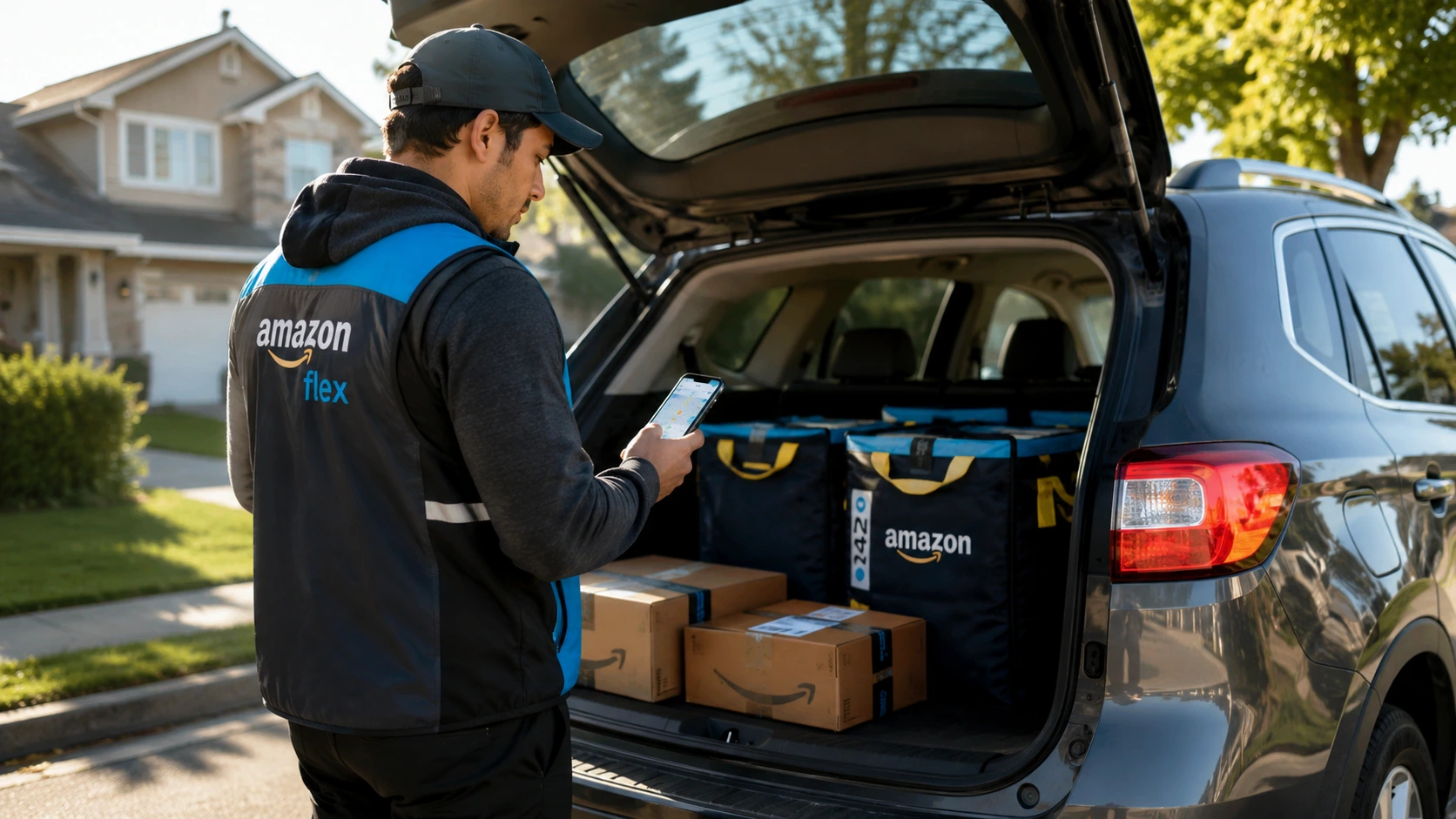
Amazon Flex works differently, with an advertised guaranteed base of $18 to $25 per scheduled hour, paid on blocks of two to six hours rather than per job. Our Amazon Flex driver pay per hour guide covers the block system in full.
| App | Pay per job | Jobs per hour | Tracked hourly (trip pay) |
|---|---|---|---|
| Instacart | $12.79 median batch | 0.96 | $12.21 median |
| DoorDash | $7.44 median delivery | 1.51 | $11.26 median |
| Uber Eats | $8.16 per delivery | 1.70 | $14.07 median |
| Amazon Flex | n/a (paid per block) | n/a | $18 to $25 advertised base |
Instacart suits earners who prefer fewer, larger jobs and don't mind the shopping work. Uber Eats sits higher on raw tracked hourly, and Amazon Flex's advertised block rates run higher still, though they aren't drawn from tracked driver data.
Is being an Instacart shopper worth it?
Instacart is worth it if you have a paid-off, fuel-efficient car, a dense or high-tip market, and the discipline to pick batches by pay against effort. It's a worse fit when your market is slow or your car is expensive to run.
Two drawbacks show up consistently in real shopper reports:
- New shoppers report below-minimum-wage days when unpaid wait time and gas pile up on a slow first week
- One unfair review can dent your access to good batches, and deactivation anxiety is a recurring theme in shopper communities
Your own logged numbers settle the question better than any national dataset. If the rate you see isn't worth your time, compare gig apps that pay the same day before committing more hours.
Some readers run the numbers and find the car-based math never works for them; an app like EarnStar, which pays real cash for playing mobile games and lets you cash out from $5, is one way to earn without gas, mileage, or a vehicle.
How to earn more as an Instacart shopper
Batch selection raises your effective hourly more than any other habit, because every earning lever traces back to how Instacart prices batches.
Pick batches by pay-to-effort, not headline pay
Judge each offer by dollars per mile and dollars per expected hour rather than the headline number. The tracked median is $2.84 per mile, so a $21.63 two-store batch across town can pay worse than a small run around the corner; NerdWallet's $21.63 offer took close to two hours and 16 miles of driving.
Item count, store count, and drive distance set the effort side of that math. A big-sounding offer with two stores and a heavy shop is slower money than it looks.
Work peak times and stack boosts
The app's peak earning times page flags the higher-paying days and hours up to a week ahead; work those and the boosted batches come to you. Keeping your rating high protects your access to good batches and any bonus pay Instacart runs in your market.
Before you tap accept, run this checklist:
- Check dollars per mile against the $2.84 median
- Count stores and heavy items before trusting the headline offer
- Favor the app's flagged peak days and hours
- Keep your rating high
- Track your net, not your gross, at the end of each week
Dead time between batches can still earn. Some shoppers fill slow stretches by getting paid to play games on EarnStar, with cash-outs from $5 by PayPal or gift card.

What Instacart pay means for your next gig decision
Instacart pays best for shoppers who treat it as a numbers game, with a paid-off car in a high-tip metro, batches chosen by dollars per mile, and hours matched to the app's peak windows. Measure a trial week against the $12.21 median and the $10 to $12 net range before you commit.
For the other big gig apps, the real-earnings breakdowns on the EarnStar blog use the same tracked data. And if the vehicle math rules out delivery work for you, start earning with EarnStar instead; it turns time you already spend gaming into withdrawable cash, from a $5 minimum.
Instacart shopper pay FAQs
Here are some of the most common questions on Instacart earnings.


Get Paid to Play!
EarnStar pays you real cash for playing games on your phone. Cash out to PayPal or 200+ other methods anytime.