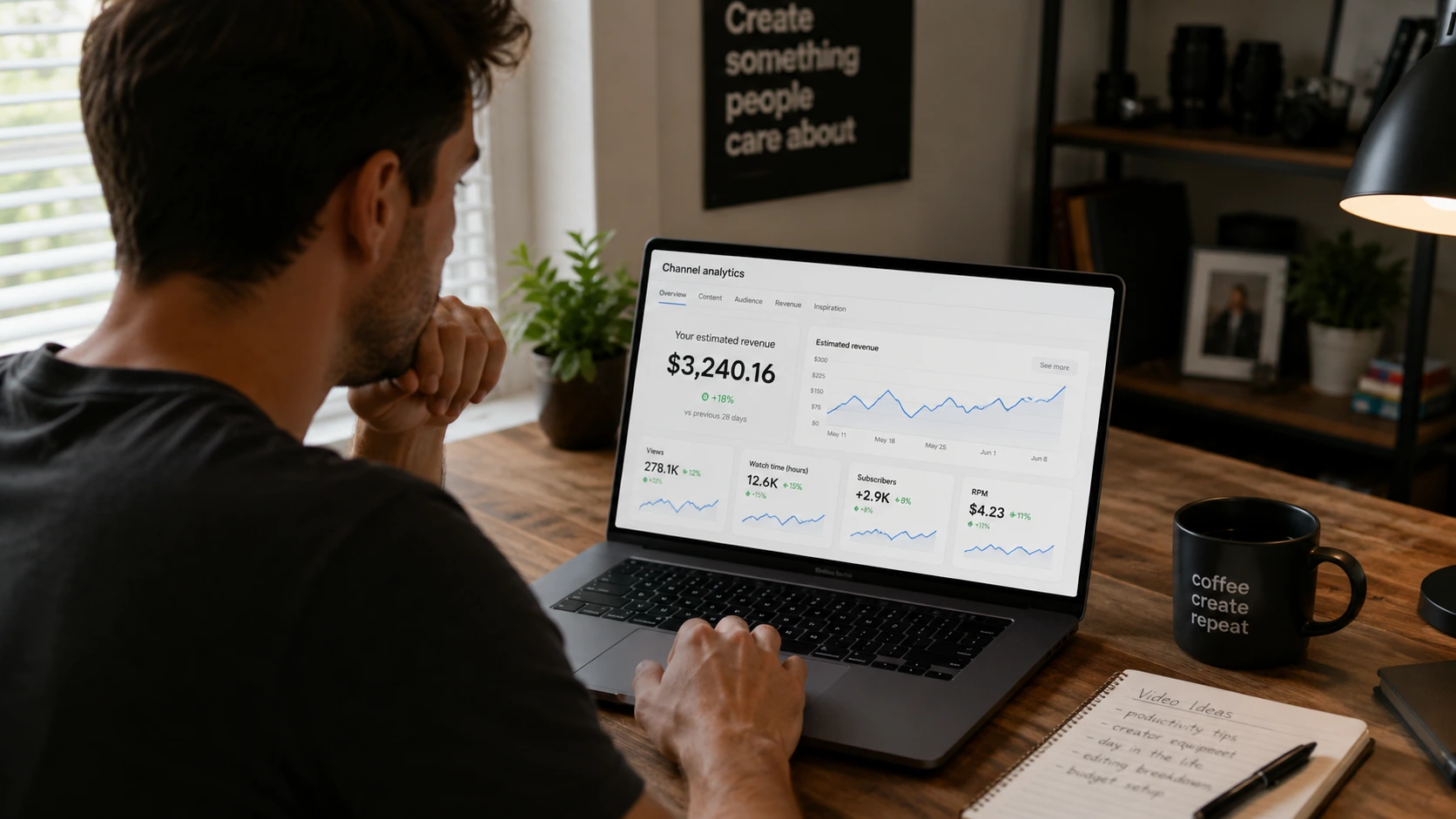
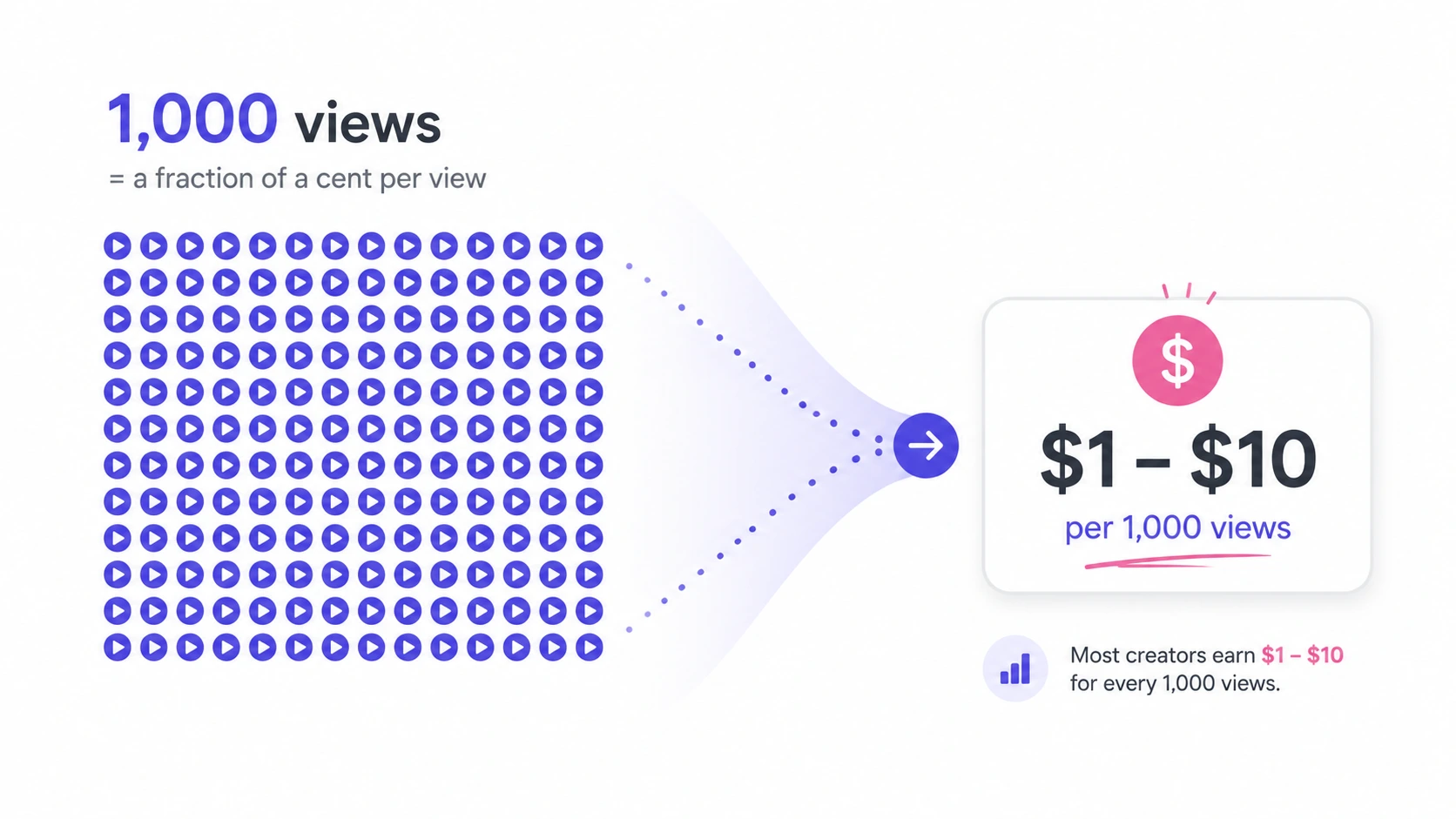
Most monetized creators earn roughly $1 to $10 per 1,000 views from ads, though industry estimates run as wide as $1 to $30 per 1,000depending on niche, audience location, and format. That number sits below the CPM your dashboard shows, because YouTube keeps 45% and only monetized views count toward your pay.
Your niche moves the rate more than anything else, closely followed by where your viewers live and the time of year you post. Ad revenue is real money that unlocks slowly, so this guide also covers the full income picture and how the effort stacks up against lower-barrier ways to earn.
How much does YouTube pay per 1,000 views?
YouTube pays most long-form creators about $1 to $10 per 1,000 views, with Stan Store putting the average RPM range at $0.50 to $10+. Where you land in that spread comes down almost entirely to your niche and who's watching.
Treat every figure here as a range, not a promise. Your real rate lives in your own YouTube Studio, and the fastest way to know your number is to read your RPM there rather than trust any single headline online.
CPM vs RPM: why your take-home runs lower
RPM is what actually lands in your account, while CPM is what advertisers pay before anyone splits it. Shopify's worked example makes the gap concrete: a $5 CPM leaves a $2.75 RPM at the 55% creator share, and the real figure drops further because CPM counts only ad impressions while RPM counts all your views.
The split itself is fixed. Creators keep 55% of long-form ad revenue and YouTube keeps 45%, per YouTube Help, and skipped ads, ad blockers, and low-demand regions pull the real figure down from there.
| Metric | What it measures |
|---|---|
| CPM | Advertiser gross per 1,000 ad impressions |
| RPM | Your revenue per 1,000 total views, after the 45% cut |
The honest per-view number
A single view earns a fraction of a cent, roughly $0.001 to $0.01, once you divide a typical RPM by 1,000. At a $3 RPM that works out to about a third of a cent per view.
The per-view figure is a useful mental model and nothing more. Real accounting happens per 1,000 monetized views, so think in thousands rather than counting pennies on each play.
What makes your YouTube pay go up or down?
Your niche leads the four levers that move your rate, alongside who is watching and where, the ad setup on your videos, and the season. Get the first two right and the same view count can pay several times more.

Your niche
Niche is the single biggest lever. Finance or tech channels earn multiples of what gaming and vlogs bring in, with Stan Store tracking personal finance at a $4 to $20 RPM against gaming near $0.50 to $3. vidIQ ties that gap to finance, insurance, and legal advertisers paying the highest CPMs on the platform.
| Niche | Typical RPM |
|---|---|
| Personal finance | $4-$20 |
| Business | $4-$15 |
| Tech | $3-$12 |
| Education | $2-$8 |
| Beauty | $1.50-$6 |
| Entertainment / vlogs | $0.50-$4 |
| Gaming | $0.50-$3 |
Who's watching, and where
Viewer country matters more than where you upload from, because advertisers pay far more to reach tier-1 audiences. MilX puts 2026 CPMs highest in the United States (around $14.67), followed by Australia (around $13.30) and Switzerland (around $12.98), with Canada near $9.93 and the UK near $8.91.
Those figures are CPM rather than RPM, which means your take-home runs lower. A channel watched mostly in the US and Australia out-earns an identical channel watched mainly in low-CPM regions.
The gap between markets is wide. MilX's lowest-CPM regions sit under a dollar, with India around $0.74, a small fraction of the US figure.
Ad type and watch time
Skippable and non-skippable ads, the number of ad breaks a video carries, and how long people watch all shift your effective rate. Longer videos leave room for more mid-roll breaks, which raises the number of ad impressions a single view can produce.
Watch time compounds the effect, since a viewer who stays to the end sees more ads than one who clicks away in the first minute. Strong retention can matter as much for your rate as the topic you pick.
Time of year
Earnings rise and fall with advertiser budgets, so November and December pay the most and January pays the least. FluxNote ranks those as the two highest-CPM months in nearly all niches, with Black Friday week spiking 30% to 60% past November's own high baseline and Cyber Monday reaching 80% to 120% above the annual average for tech, gaming, and retail-adjacent channels.
The reset is sharp. TubeLab recorded December 2024 CPMs near $5.70 collapsing to about $1.98 by January 2025, a drop of nearly two-thirds as brands pause spending, which is why a channel can look like it lost money overnight without doing anything wrong.
June through August also runs below average in FluxNote's data, since summer brings high views but low advertiser competition. The same views can be worth nearly three times as much in December as in January.

Realistic earnings at 100k, 1 million, and beyond
At a $3 to $10 RPM, 100,000 views earns roughly $300 to $1,000 and 1 million views earns roughly $3,000 to $10,000, per TubeLab's view-to-earnings math. Low-CPM niches land near the bottom of each band, and finance or tech push toward the top or beyond.
The table below shows the low, average, and high cases side by side, so plug in the RPM from your own Studio to see where you sit.
| View count | Low RPM (~$3) | Mid RPM (~$6) | High RPM (~$10) |
|---|---|---|---|
| 100,000 views | ~$300 | ~$600 | ~$1,000 |
| 1,000,000 views | ~$3,000 | ~$6,000 | ~$10,000 |
What 100,000 views pays
Expect around $500 to $700 for 100,000 views on an average channel, per Views4You. Finance, tech, and real estate can reach $1,000 to $4,000 or more, while gaming and entertainment channels see closer to $200 to $800 for the same views.
Education sits in between at roughly $800 to $2,500 for 100,000 views. The spread across niches is the whole story here, since one viral video can pay a beauty creator a few hundred dollars and a finance creator several thousand for the exact same reach.
What 1 million views pays
One million views pays roughly $2,000 to $8,000 in the average range, according to Mediacube. Low-CPM niches can bottom out near $1,000, the general high end runs $10,000 to $15,000 or more, and Mediacube's finance benchmark stretches to $25,000.
What do YouTubers actually make?
Most YouTubers earn far less than the headlines suggest. The median full-time creator makes about $3,000 a year, down from roughly $3,500 two years earlier, and only about 4% of creators globally earn more than $100,000 a year, per Forbes data cited by CreatiCalc.
That gap between the median and the mega-earners is the part most new creators miss. The top 10% of creators now take 62% of all ad payments, up from 53% in 2023, so the eye-catching averages are dragged up by the biggest channels.
The median vs the outliers
The middle of YouTube is modest and the top is enormous, which is exactly why quoting an average misleads. Look at how much Kai Cenat earnsand the number runs into the millions, far above anything a typical channel sees.
The same holds across the streaming world, from Shroud's earnings breakdown to how Ninja built his income across ads, sponsorships, and deals well beyond YouTube. Those are the outliers the median never reaches, so treating them as normal sets a false benchmark for your own channel.
Median full-time creator: ~$3,000 a year. Creators earning $100,000+ a year: ~4%.
What small channels really earn
A channel with a few thousand subscribers brings in a few dollars to low tens of dollars a month, not a salary. Run your own numbers instead of guessing, multiplying your monthly views by your RPM and dividing by 1,000.
A channel getting 20,000 views a month at a $4 RPM earns about $80, before any other income stream. That math is why patience and niche choice matter so much early on.
New creators tend to benchmark against millionaires when the fairer comparison is a channel their own size. At realistic small-channel view counts, ad revenue alone rarely covers more than a phone bill, which is why the income streams in the next section matter far more than the ad rate for anyone starting out.
How many subscribers do you need to make money on YouTube?
Subscribers don't pay you directly; watch hours and monetized views do. The ad-revenue gate is 1,000 subscribers plus 4,000 valid public watch hours in the past 12 months, or 10 million valid public Shorts views in 90 days, per the YouTube Partner Program.
That threshold trips up a lot of new creators who assume hitting a subscriber count flips on the money. It doesn't; the hours and views behind those subscribers are what count.
The two YPP tiers
There are two doors into the Partner Program. Early access opens at 500 subscribers plus 3 uploads in the past 90 days, alongside 3,000 watch hours in the past year (or 3 million Shorts views in 90 days), and it unlocks fan funding like memberships and Super Chat, but not ad revenue, per YouTube Help.
The full ad-revenue tier needs 1,000 subscribers and 4,000 watch hours. The table shows what each tier requires and what it turns on.
| Tier | Requirements | What it unlocks |
|---|---|---|
| Early access | 500 subs + 3 uploads + 3,000 watch hours (or 3M Shorts views) | Memberships, Super Chat, Super Thanks, Shopping |
| Full ad-revenue | 1,000 subs + 4,000 watch hours (or 10M Shorts views) | Ad revenue plus all fan-funding features |
When money actually reaches you
You get paid once your balance clears the $100 AdSense threshold, with payments going out between the 21st and 26th of the month, per Google AdSense Help. Fall short of $100 in a given month and the balance rolls forward until it clears.
Subscriber counts don't set your payout, even at the million mark. A million subscribers earns nothing on its own; the money still comes from views, watch time, and the income streams covered next.
How else do YouTubers make money?
Ad revenue is only one stream. Memberships, tips, and sponsorships regularly out-earn ads once a channel has a real audience, and YouTube's own fan-funding tools pay creators a better share than ads do.
- Channel memberships, priced $0.99 to $49.99 a month
- Super Thanks and Super Chat tips
- Sponsorships and brand deals
- Shopping and product tags
Fan funding: memberships and tips
Memberships and tips pay creators 70%, better than the 55% share on long-form ads, a split HowSociable confirms for memberships, Super Chat, and Super Thanks alike. Membership pricing runs $0.99 to $49.99 a month, per CreatiCalc.
That higher share is why a channel with a loyal core can earn more from a few hundred members than from ads on the same videos. Fan funding rewards depth of audience over raw view count.
Sponsorships and brand deals
Sponsorships are where the real money sits, worth roughly $50 to $100 or more per 1,000 views, which dwarfs ad RPM. TubeLab puts brand deals at 5 to 20 times what ads pay for the same views, citing the example of a channel earning $2,000 a month from ads that pulls $8,000 a month from a single recurring sponsorship.
At those rates, a view is worth far more once you have an audience a brand wants to reach. A single view that pays a fraction of a cent in ad revenue can be worth cents in sponsorship value.
Established creators rarely lean on a single stream. The biggest incomes stack ads, memberships, sponsorships, and merch together, so the channels that earn most treat ad revenue as a floor rather than the ceiling.
How much do YouTube Shorts pay per 1,000 views?
Shorts pay far less than long-form video, typically $0.05 to $0.09 per 1,000 views and up to about $0.15 in strong niches, per Influencer Marketing Hub's Shorts data. Mediacube pegs many channels lower still at $0.01 to $0.05, so against a typical $3 long-form RPM, a Short earns a small fraction of what a regular video does.
| Format | RPM per 1,000 views | Per 1 million views |
|---|---|---|
| Shorts | $0.05-$0.09 (up to ~$0.15) | ~$50-$150 |
| Long-form | ~$3 | ~$3,000 |
Why Shorts pay less, and can you monetize them
Shorts are monetizable through the Creator Pool, which pays creators 45% of their allocated share of pooled ad revenue, and a licensed-music track sends about 50% of that Short's revenue to the rights holders first, per YouTube Help and Influencer Marketing Hub. Stacking two splits on a low base is why the per-view number stays tiny.
Treat Shorts as reach rather than income. At roughly $30 to $200 per million views, per TubeLab, they build an audience and feed your long-form catalog far better than they pad your bank balance.
YouTube vs faster ways to earn: effort against payout
YouTube ad revenue is real, but it's back-loaded, so expect months of unpaid uploads, often a year or more, before you clear the Partner Program gate. Even then the median creator earns around $3,000 a year, a payout most people find underwhelming for the hours involved.
What YouTube gives you is an audience in exchange for a long stretch of time before any money arrives, so the trade-off is worth weighing against options with a lower barrier to entry.
The real timeline and effort of YouTube income
The effort is front-loaded and unpaid. Hitting 1,000 subscribers and 4,000 watch hours takes most creators many months to well over a year, and the median payout afterward is still modest.
Compare that to same-day earning options. Gig apps that pay the same day put cash in your account within hours of finishing work, and what Uber Eats pays per delivery is money you keep after a single shift rather than after a year-long climb.

A lower-effort way to start earning now
If your goal is money rather than an audience, options that pay from day one skip YouTube's unpaid ramp entirely. EarnStar pays real cash for playing mobile games, with surveys and tasks as a second path, and it's free to use with cash-outs from $5 by PayPal or gift card.
There's no channel to build and no year-long wait for a threshold, which suits anyone who wants reliable side income now. It's realistic side money rather than a YouTube-sized payday.
Is a YouTube channel the right earning move for you?
YouTube pays roughly $1 to $10 per 1,000 views, rewards patience and the right niche, and pays best once you stack ad revenue with memberships and sponsorships. It's a slow build, so choose it if you genuinely want to grow an audience over time.
If you mainly want income now, pair it with faster options rather than banking on ad revenue alone. For more honest earning breakdowns like this one, the EarnStar blog runs the numbers on creators, gigs, and side hustles worth your time.
Frequently asked questions
Quick answers to the questions creators ask most about YouTube pay.


Get Paid to Play!
EarnStar pays you real cash for playing games on your phone. Cash out to PayPal or 200+ other methods anytime.