Amazon doesn't pay shoppers to write reviews. Taking money for one breaks the Community Guidelines every Amazon.com customer agrees to.
The Guidelines define compensation broadly enough to catch a gift card or a partial refund, so accepting any of it for a review puts your account at risk. A consumer who accepts money for a five-star review doesn't violate the federal Consumer Reviews and Testimonials Rule, which binds only the business providing the payment.
Amazon's own rule is the one that can close your account. Federal penalties land on whoever pays for the review, and the people still making offers are the ones hardest to trace.
Can you actually make money on Amazon reviews?
No Amazon program pays cash for a review. Selling your star rating isn't a side hustle any legitimate platform offers.
Two rule sets govern this topic, each binding a different party. Shoppers answer to Amazon's Community Guidelines.
The FTC's Consumer Reviews and Testimonials Rule binds whoever pays for the review, and the financial penalties sit on that side.
Amazon bans paid reviews for shoppers
Amazon's rules prohibit creating, editing, or removing a review in exchange for compensation. That definition is wide, covering payments, refunds, discounts, products, gift cards, warranties and services.
The ban runs both ways. Taking a refund to remove or change a negative review breaks the same guideline as taking cash for five stars.
"You can only receive free products through the official Vine program offers. Accepting free products or compensation directly from sellers or brands in exchange for reviews is strictly prohibited."
Amazon publishes four consequences for community violations, and two of them reach your money. The company can suspend or terminate an account, and it can withhold payments.
The FTC rule fines the business, not the reviewer
The FTC's Consumer Reviews and Testimonials Rule, in force since October 21, 2024, bars a business from providing compensation conditioned on a review's sentiment, either positive or negative. Shoppers who write the reviews carry no obligation under it.
In the FTC's own Q&A, Section 465.4 applies only to the businesses that provide compensation, and ordinary consumers can't be liable under the rule for review content.
Brokers sit inside the rule alongside the brands. A reputation-management firm that pays for sentiment-conditioned reviews carries the same liability, and the civil penalty runs to $53,088 per violation, an inflation-adjusted maximum that took effect in January 2025 and replaced $51,744.
| Rule | Who it binds | What a violation costs them |
|---|---|---|
| Amazon Community Guidelines | Shoppers who write reviews | Content removal, restricted community features, account suspension or termination, withheld payments |
| FTC Consumer Reviews and Testimonials Rule | The paying side, from brands to brokers and reputation-management firms | Civil penalties up to $53,088 per violation |
Amazon Vine, the one review route Amazon runs itself
Vine is the only route Amazon allows for receiving free product in exchange for a review. Any other free-product arrangement with a seller breaks the guidelines above.
The rules of that trade are Amazon's alone, from who gets in to what a Voice owes back.
How Amazon Vine works
Amazon Vine is a genuine Amazon program that hands selected reviewers free product in exchange for a published review. Membership is invitation-only, with Amazon selecting Voices from shoppers already reviewing in the store.
Enrolled Voices can request products from thousands of participating brands, shipped to their doorsteps at no cost.
"Amazon Vine reviews are distinguished with this special badge 'Vine Customer Review of Free Product' for full transparency."
That badge appears on every Vine review, so the free-product relationship is disclosed to whoever reads one. It also means a Vine review can't be passed off as an ordinary customer opinion.
Vine is legitimate because Amazon runs it. A seller emailing you a free-item offer is not.
What Vine reviewers actually receive
Vine Voices receive free product and no money at all.
"Voices are shoppers like you and are not paid to participate in the program."
What a Voice takes home is the retail value of the products they requested, in the form of the products themselves. None of it reaches a bank account.
The trade still has takers. A household that would've bought the item anyway keeps the cash it didn't spend, though the product's value still counts as income.
Readers who came here for money are looking at a different category of app. Free apps that pay real cash run on withdrawable payouts.
How to get invited to Amazon Vine
You can't apply to Amazon Vine, and no published review count triggers an invitation. Selection sits entirely with the company.
The criterion Amazon publishes is qualitative: customers who consistently write insightful reviews are most likely to be invited.
- Amazon's wording rewards consistency, which rules out a single burst of reviews
- Insightful means telling a shopper something the listing leaves out
- Once you're in, honest and unbiased reviews are what keep you there
Writing reviews a stranger would find useful, on products you actually bought, is the only thing you control here.
Amazon Vine taxes
The value of the product a Vine Voice receives is reportable income. The IRS sets the reporting floor for payments made in 2026 at $2,000.
"File Form 1099-NEC, Nonemployee Compensation, for each person in the course of your business during the year to whom you have paid at least $2,000"
That $2,000 figure replaced the $600 threshold still repeated across older guides and forum threads, and it adjusts for inflation from 2027.
The threshold governs when a payer files a form, not whether the income is taxable. Product value below it still belongs on your return, even when no form arrives.
Anyone weighing Vine against a route that deposits money should count that tax as part of the cost. The other half of that comparison sits in our guide to cash-out proof and payout timelines.
Is Amazon Vine worth it?
Vine is worth it for a shopper who wants free product and accepts a tax bill on its value. Nobody else gets a return on the writing time.
Every cost in that trade is set by Amazon, from the mandatory badge on each review to the absence of any cash payment.
| What you get | What it costs you |
|---|---|
| Free product from thousands of participating brands | Reportable income on the retail value of everything you accept |
| Cash you'd have spent on an item you wanted anyway | Each item you request comes with a review you owe |
| Nothing to pay upfront on anything you request | A permanent badge on every review you publish |
| A program Amazon runs itself, so your account stays safe | Selection stays with Amazon, and there's no application to file |
Amazon programs that pay actual cash
Amazon pays individuals for what their audience does, never for the review itself. Both routes below run on commission, and the Associates rate card adds a short list of flat Bounty Events.
Amazon Associates commissions
Amazon Associates pays a fixed percentage of qualifying revenue, sized by what the buyer ends up purchasing. Published rates top out at 10% and fall to 0% on gift cards, wireless service plans and alcoholic beverages, leaving 1% as the lowest rate that pays anything.
The review itself earns nothing. Commission arrives only when a qualifying sale completes through your link, so affiliate reviewers write for readers ready to check out.
| Category group | Commission rate |
|---|---|
| Luxury Beauty, Luxury Stores Beauty, Amazon Explore | 10% |
| Physical Books, Kitchen, Automotive | 4.5% |
| Toys, Furniture, Home, Home Improvement, Lawn & Garden, Pets Products, Headphones, Beauty | 3% |
| Televisions, Digital Video Games | 2% |
| Amazon Fresh, Physical Video Games & Video Game Consoles, Grocery, Health & Personal Care | 1% |
Category matters more than volume at small scale. A $100 luxury beauty order returns $10, while $100 in grocery returns $1.
The categories a product reviewer covers most, home goods and electronics, sit nearer the bottom of that spread than the top. Bounty Events on the Associates rate card pay a flat fee per qualifying signup, membership purchase or video stream.
The Influencer Program and Shoppable Videos
The Amazon Influencer Program is the closest route to being paid for reviewing on Amazon. Amazon accepts applications from anyone with a YouTube, Instagram, Facebook or TikTok account, then weighs follower count alongside engagement.
Readers arrive expecting a per-review fee, and the program pays nothing of the kind. Amazon pays commission when your followers make qualifying purchases via your affiliate links, sized by what those followers actually buy.
Shoppable Videos place that video content on Amazon itself, a format that needs an active Storefront and pays through the same commission mechanism. Creators weighing this against their own channel should look at TikTok's per-view math, since the Influencer Program accepts TikTok accounts and the two pay on different triggers.
Routes off Amazon that pay cash for feedback
Feedback work that pays in money exists off Amazon entirely. Research panels, product-testing platforms and reward apps all buy your time.
None of these routes touches your Amazon account.
Paid user research and product testing
Companies pay real money for an hour of your opinion. A remote one-to-one consumer interview carries a recommended incentive of $80 per hour, drawn from a dataset of nearly 20,000 completed research projects.
| Session type | Recommended incentive |
|---|---|
| Consumer 1:1 interview, remote | $80 per hour |
| Consumer 1:1 interview, in person | $90 per hour |
| Professional 1:1 interview, remote | $85 per hour |
| Professional 1:1 interview, in person | $140 per hour |
Product testing pays per completed test. UserTesting sends payment by PayPal 14 days after a test is completed, with the amount set by customer demand, the test type and the tasks included.
Comparing several panels beats committing to one. We've covered eight platforms that pay for product testing off Amazon in a wider roundup, including which ones actually pay out.
Reward apps that pay for small tasks
Reward apps pay small amounts in actual cash. Nobody replaces a salary this way.
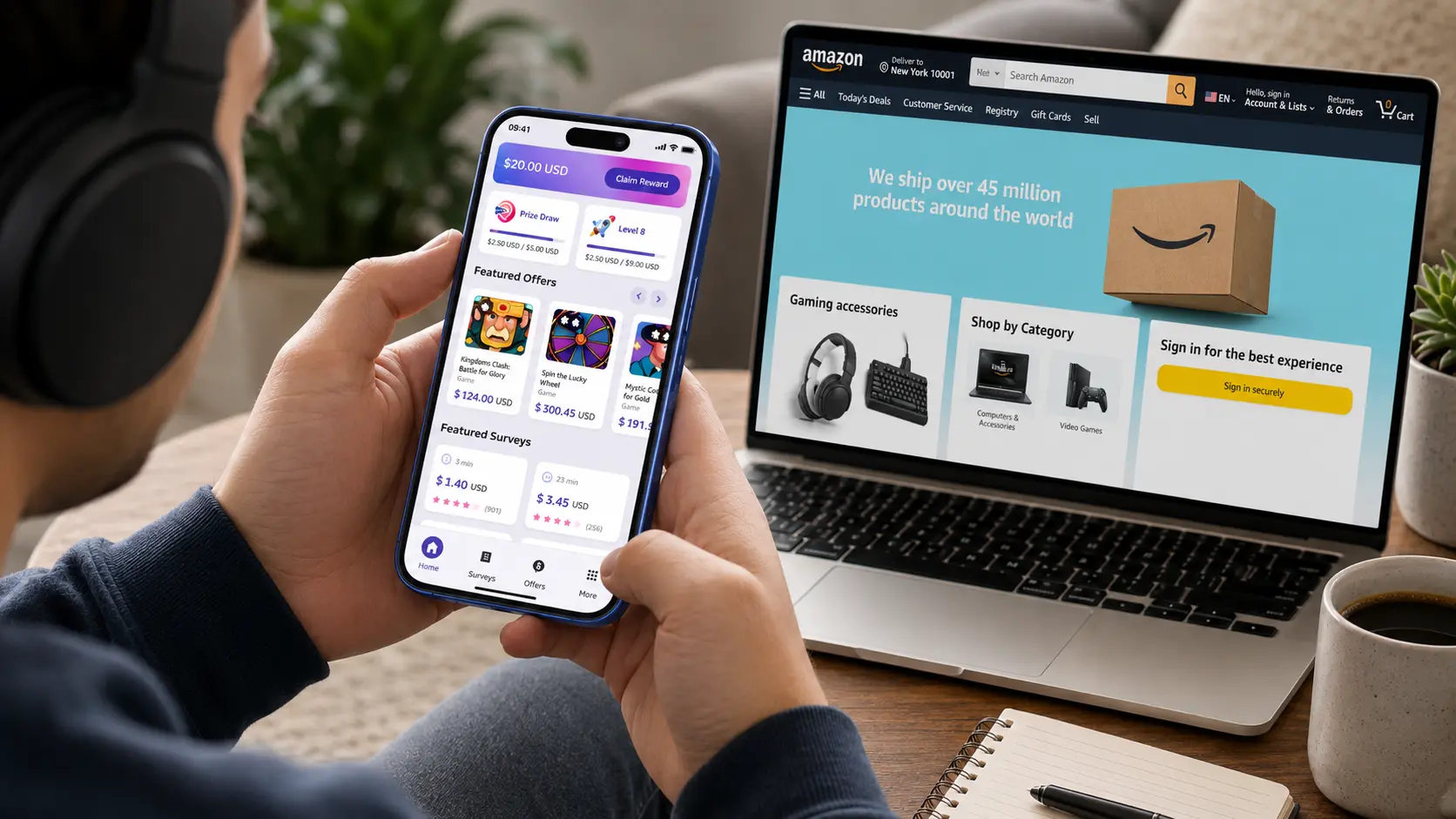
- We built EarnStar around mobile games that pay in withdrawable cash, with surveys and tasks behind them; cash out starts at $5 by PayPal or gift card
- TopSurveys, also ours, covers the survey-led side for anyone who'd sooner answer questions than play
- For readers who care most about speed, our roundup of gig apps that pay the same day sorts platforms by how fast the money lands
- Store credit suits anyone who'd spend it there anyway; we've tested gift card apps side by side
What these have in common is a payout you can actually collect, in cash or in credit you pick yourself. You can start earning with EarnStar on iOS, Android or the web, free to use.
How to spot a paid-review scam
Paid-review offers reuse a small stock of scripts, and Amazon quotes two of them in its own violation examples. Recognizing the wording sorts a scam from a real program in about five seconds.
The messages reach people through social platforms and Amazon's own inbox.
Two of the scripts Amazon publishes as violations
The prize script offers a gift card you've supposedly already won.
"You're our lucky winner of a $50 Gift Card! To claim your prize, leave a 5-star review."
Refunds drive the other script, which reaches shoppers through social media and Buyer-Seller Messaging. You keep the product and the money comes back.
"Send your order number or a screenshot to [email protected]. Our support team will process a refund for you when you leave us a review. You also don't need to return [product]."
Both scripts break the same rule. Our list of Amazon gift cards you can earn legitimately covers routes that involve no review at all.
Why the offers arrive through Facebook and anonymous accounts
Brokers carry the same $53,088 exposure the brands do. They answer it by staying unidentifiable, which is why an offer arrives from a throwaway account rather than a company address you could report.
The FTC's warning on game-like online job scams targets offers that attach a payment to a specific rating, and the illegality it names falls on the company making the offer. That's a different transaction from paid research, which buys your time whatever you conclude.
"Don't trust anyone who says they'll pay you to rate or 'like' things online. That's illegal and no honest company will do it."
Facebook led every other social platform for money reported lost to scams that started there in 2025, which is where a review offer is most likely to find you.
Amazon blocked over 275 million suspected fake reviews from its store in 2024. Offers still reach shoppers through the social channels above.
Red flags in a paid-review offer
One signal here is enough to walk away from the offer.
- A specific star rating is attached to a payment or gift card offer
- You're told to keep the product and send an order number
- Facebook, Telegram or Buyer-Seller Messaging carried the message
- You can't find a company name anywhere in it
What the five routes actually pay, on Amazon and off
Only one of these five routes pays in merchandise, and Amazon runs that one itself.
| Route | What it pays | What it costs you | Who it suits |
|---|---|---|---|
| Amazon Vine | Free product, no cash | Tax on retail value, plus a review per item | Shoppers who want free product more than cash |
| Amazon Associates | Up to 10% commission by category | Traffic that converts before anything pays | Bloggers, YouTubers and newsletter writers |
| Influencer Program and Shoppable Videos | A cut of whatever your followers buy | An active Storefront plus production time | You post product videos to a following |
| Paid user research | $80 to $140 per hour by session type | Payment lands after the work, not on signup | Anyone with an hour to give an interviewer |
| Reward apps such as EarnStar | Small cash amounts per task or game | Time in short blocks, modest returns | Casual gamers fit these into dead minutes |
Anyone thinking in hourly rates should set these against how Amazon Flex pay breaks down. For a creator-side floor, there's what YouTube pays per 1,000 views.
Your next step if you wanted cash, not free product
Amazon pays nothing for an opinion. Every route named on this page pays through a commission, a flat bounty, a research session, or a completed task.
Vine suits a shopper who genuinely wants the free product, though you can't put yourself forward for it and the retail value follows you onto a tax return.
EarnStar sits at the other end of that choice, paying for game sessions and short tasks in money you withdraw. Readers looking wider will find more routes in our guide to extra money on the side and across the EarnStar blog.
Frequently Asked Questions
Amazon's own pages and the federal rules answer most of what readers ask next.


Start earning cash instead of free product
Reviews earn you nothing on Amazon. EarnStar pays real cash for playing mobile games, with surveys and tasks as a second route.