
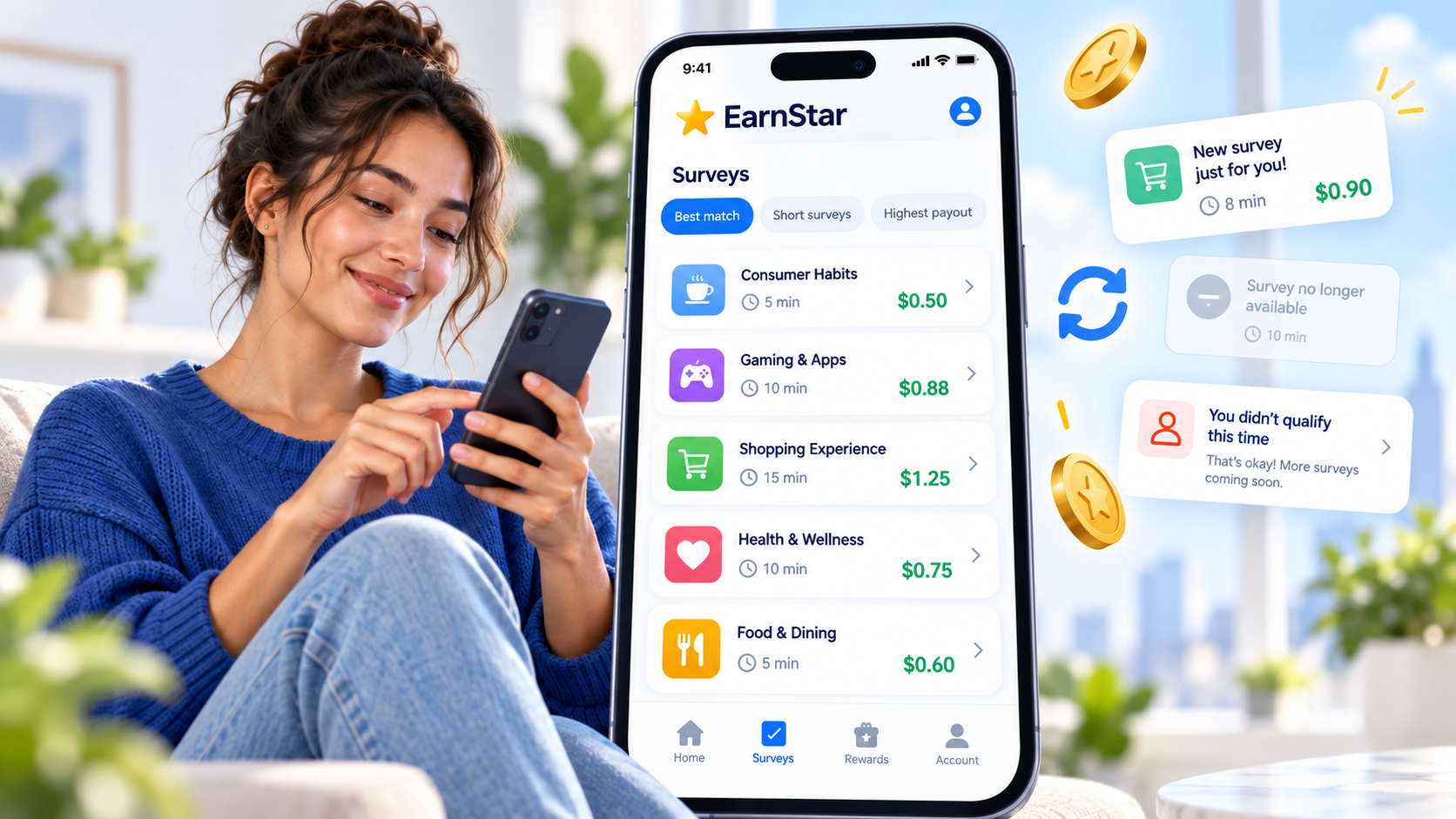
Surveys are a secondary way to earn inside EarnStar. Games are the main path, and the studies themselves come from outside research partners, not from us, which is why the list you see shifts from one day to the next.
This page covers what a survey is worth against the time it takes, why the available number moves, and what happens when a study screens you out partway through. There's no guaranteed daily total here, and no single rate that fits every survey.
The surveys tab sits inside EarnStar, next to games and offers, one of many free apps that pay real money you can withdraw from.
How EarnStar surveys work
The surveys tab is one of several ways to earn in EarnStar. The studies inside it come from partner research companies rather than from EarnStar directly.
What you see in the surveys tab
Open the surveys tab and you'll see a list of studies that are live right now, each one tagged with the time it's expected to take. A survey here is a paid market-research questionnaire, run by a partner company that wants structured opinions from people who match a certain profile.
Most take about 5 to 15 minutes, though the length varies from one study to the next. The estimate sits on the study before you open it, so you can judge whether it's worth your time.
If you're new to the app, how to use EarnStar walks through where the tab sits and how to get set up.
How surveys, offer walls, and games fit together
Surveys are one lane, with games as the main one and offer walls alongside both. A thin survey list never means there's nothing to do.
The money behind all of it works the same way. Partner companies pay EarnStar to reach real respondents and players, funding the rewards that land in your balance.
That model is worth understanding if you want to know whether EarnStar is safe before you put time in. If games are what brought you here, games that pay real money covers the main path in more depth.
How many surveys you see, and why the number moves
Across the whole platform, EarnStar runs around 2,300 surveys on a typical day, but that's the size of the pool, not the number in front of you. What reaches your tab is the slice you personally qualify for, never a single fixed number.
What changes how many surveys you see
A handful of things decide how many studies you can open at any moment. The biggest is how well your profile matches what partners screen for.
- Profile completeness, since partners target studies using what they already know about you.
- Country and device, which some studies restrict.
- Time of day, because studies open and fill on their own schedules.
- How many partner studies are live and still short of respondents.
In research terms this is the incidence rate, the share of a sample eligible for a given study. When a study's criteria are narrow, that rate drops, so even a large audience produces only a few qualifiers, leaving your list thin through no fault of yours.
Why the list refreshes
The list refreshes constantly because partners add roughly 1,800 new surveys a day across the platform, while older studies close as they hit their limits. A study doesn't stay open forever.
Once a partner has enough responses from a given group, the quota for that segment closes automatically and the study drops off. Availability tracks live partner demand rather than a clock, which is why checking back later can surface studies that weren't there an hour ago.
What EarnStar surveys pay
The list keeps refreshing with new studies, each showing its estimated time before you start, so you can deliberately pick the short ones. Surveys sit behind games as a secondary earner, and across all of them the average payout is about $0.88 per survey, set by the study itself rather than a flat EarnStar rate.
Why the length of a survey drives what it pays
Pay scales with length because your time is what a study is buying. A quick check-in survey is worth less to a partner than a long, detailed interview, so the longer one pays more.
The $0.88 figure is an average across surveys, and individual payouts sit above and below it depending on how much a study asks of you, so a run of short studies works out differently from a single long one.
For a realistic sense of how survey pay adds up alongside games and offers early on, earn your first $50 on EarnStar lays out a grounded timeline with no income guarantee.
Check the estimated time before you start
Every study shows its estimated time before you open it, so you can match a survey to the pocket of time you have.
Ten minutes covers a couple of short studies. A longer stretch fits the bigger ones that pay more.
This is where the filters at the top of the tab come in, sorting what's available by fit, length, or payout before you commit. Surveys aren't the only place partners pay for opinions; getting paid to review products is a close cousin where the feedback covers specific items rather than a broad questionnaire.
Using the survey filters to raise your rate
Matching the right filter to the time you have is the biggest lever you control over your rate. The studies come and go on their own, but how you sort them is up to you.
EarnStar puts three filters at the top of the surveys tab so you can order what's available before you open anything:
- Best match surfaces the surveys you're most likely to qualify for.
- Short surveys brings the quickest studies to the top when your time is tight.
- Highest payout lists the biggest-paying studies first, which tend to be the longer ones.
None of these change what a survey pays. They change how quickly you find the ones worth your time.
The filters reset as the list refreshes, so the best match this hour may differ from the one earlier. If you only have a few minutes, opening a best match or sorting by short surveys beats scrolling the full list and hoping.
Screen-outs, and why a disqualification isn't wasted time
A screen-out means a study decided you fall outside the specific group it needs, or that it filled its quota for people like you before you finished. It isn't a mark against you or a sign you did anything wrong.
Why studies screen people out
Every study opens with a short set of screening questions that check whether you fit its specific target audience. If your answers place you outside that group, it ends the attempt early.
Quotas work from the other side. Once a study has collected enough responses from people like you, that segment closes and you can be screened out partway through even when you seemed to match at the start.
None of this is personal. It happens on every research platform, so if a survey freezes, errors, or fails to credit when it should have, contact EarnStar support can sort out what went wrong.
What happens when a survey screens you out
A screen-out still returns something. EarnStar has a screenout payout, so an attempt that ends early because a study filled up or ruled you out doesn't leave you with nothing for the minute you spent.
It's a small amount rather than the full survey reward. Completing your profile questions gives partners more to match studies against, and the best match filter surfaces the surveys you're most likely to qualify for.
What to do when few surveys show up
When your list looks thin, the highest-impact fix is to finish your profile questions, because partners can only match you to studies using what they know about you. Checking back at a different time helps too, since the pool refreshes through the day.
Finish your profile questions
A complete profile widens the set of studies you can qualify for. Every question you answer gives partners another attribute to match against, which lifts your incidence across their studies and puts more within reach.
This is the same mechanic behind a thin list. Fewer known attributes mean fewer studies can confirm you fit, so the tab stays sparse until you fill the gaps.
Filling in the profile section once tends to pay off across every session after.
Switch to games and offers while the list is thin
While surveys are quiet, the games and offer walls keep earning from the same balance. Games are the primary path anyway, making a slow survey day a good time to lean on them.
Offer walls add another layer, paying for things like trying an app or completing a task. If gaming is the part you'd enjoy most, getting paid to play video games breaks down how that side works, and real money games on EarnStar covers which titles actually pay.
Where your survey earnings go
Survey earnings land in the same balance as everything else you earn in the app. There's no separate survey wallet, so a dollar from a study sits next to a dollar from a game or an offer.
Because the balance is shared, the withdrawal process is identical no matter what produced the money. The full picture of how EarnStar payouts work lives in its own guide, including the methods available and how long each one takes.
When you're ready to cash out your balance, that walkthrough covers the steps end to end. Whatever mix of surveys, games, and offers got you there, the money moves out the same way.

Getting more from the surveys tab
Three habits decide how much the surveys tab returns. Keep your profile complete so more studies match you, sort with the filter that fits the time you have, and treat a screen-out as the normal cost of research rather than wasted effort.
Surveys are one path, not the whole app, and the steadiest approach uses them alongside games and offers, so a quiet survey day never means a quiet earning day, and there are other ways to make money from home worth folding into the same routine.
Frequently Asked Questions
A few quick answers to the questions people ask most about earning through EarnStar surveys.


Turn your spare minutes into surveys and games
EarnStar keeps surveys and games in one app, and every study shows its estimated time before you start, so you can earn around whatever your day looks like.